Paul Samuelson Quotes
What good does it do a black youth to know that an employer must pay him $2 an hour if the fact that he must be paid that amount is what keeps him from getting a job?
Samuelson, Paul A. Economics. 9th ed., McGraw-Hill, 1973, p. 394.


This is a statement that in the early 21st century would be made only by ultra liberals. But in the in the late 1940’s this was not only standard democratic party thinking, but a large number of Republicans thought of the Government as the employer of last resort including their Presidential standard bearer.


This is the classic conservative argument against raising the minimum wage. Historically, if the minimum wage was raised well after there has been a period of wage inflation, there has been little or no negative effect on the lowest paid workers. However, when the minimum wage has been raised during a period of wage stability, there is an effect of making some workers simply not worth the rate that they must be paid. However, even then, after a year or two, the negative effect begins to dissipate.


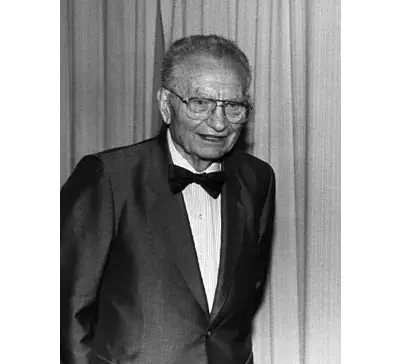
Paul Anthony Samuelson (May 15, 1915 – December 13, 2009) was an American economist who was the first American to win the Nobel Memorial Prize in Economic Sciences. When awarding the prize in 1970, the Swedish Royal Academies stated that he "has done more than any other contemporary economist to raise the level of scientific analysis in economic theory". Economic historian Randall E. Parker has called him the "Father of Modern Economics", and The New York Times considers him to be the "foremost academic economist of the 20th century".
