Saint Augustine Quotes
What art Thou then, my God? what, but the Lord God? For who is Lord but the Lord? or who is God save our God? Most highest, most good, most potent, most omnipotent; most merciful, yet most just; most hidden, yet most present; most beautiful, yet most strong; stable, yet incomprehensible; unchangeable, yet all-changing; never new, never old; all-renewing, and bringing age upon the proud, and they know it not; ever working, ever at rest; still gathering, yet nothing lacking; supporting, filling, and overspreading; creating, nourishing, and maturing; seeking, yet having all things.
Augustine. Confessions. Translated by E.B. Pusey, J.H. Parker, 1838, p. 3.


At the time, it was very difficult for people who had been taught all their lives that God was directly responsible for the creation to accept the notion of evolution. At the time, there was not the overwhelming evidence proving Darwin’s theory that we have today. Nor did theologians realize that evolution and Darwinism were not inconsistent with the concept of a creator and supreme being. Nonetheless, there are still those who, like Agassiz, reject evolution and insist that the Biblical version of creation is literally true. See {586990}. Then there are people who have come up with the concept of Intelligent Design which originated with Agassiz though he never called it that. Most religious people today, in contrast, see no conflict in natural selection as described by Darwin and later proven, and the concept of God. They see the Biblical creation as metaphorical and natural selection as the product of an omniscient supreme being.


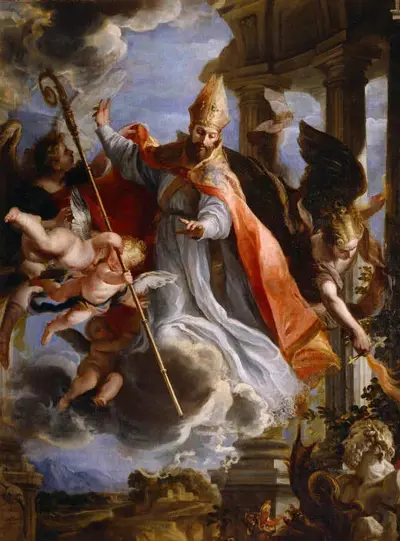
Augustine of Hippo, also known as Saint Augustine, was a theologian, philosopher, and the bishop of Hippo Regius in Numidia, Roman North Africa. His writings influenced the development of Western philosophy and Western Christianity, and he is viewed as one of the most important Church Fathers of the Latin Church in the Patristic Period. His many important works include The City of God, On Christian Doctrine, and Confessions.
