Robert Crippen Quotes
We were on the dark side of the Earth when we started to see outside the window this soft pink glow, which is a lot of little angry ions out there going very fast. We were hitting them very fast.
Crippen, Robert L. Interview by Rebecca Wright. NASA Johnson Space Center Oral History Project, NASA, 26 May 2006.


Dr. Snyder was the youngest physicist at Los Alamos working on the Atom Bomb Manhattan Project. James Alfred Van Allen (1914–2006) had theoretically predicted that there was a “belt” of small rocks and pebbles around the solar system in a particular orbit but his hypothesis could not be confirmed because the rocks of the belt would be too small to be detected by the telescopes and sensors of the time. Snyder, at the Jet Propulsion Laboratory, was the head of a team that launched a rocket into the stratosphere whose sensors could detect much smaller objects than ever before because there was no interference from the Earth’s atmosphere. The sensor signals were radioed back to Snyder’s computers which produced thousands of pages of wide paper, line printer output which then had to be read and deciphered. Snyder took them home to start the deciphering process. Snyder’s wife Marjorie, had been used to helping with the mathematical process. At 2 AM, with the print outs spread on their living room floor, they “saw” the many small objects exactly where Van Allen predicted they would be. After savoring the fact that they knew something that no one else in the world knew, they called Professor Van Allen who was delighted to be awakened with the news. See related quote for another example of a scientist who made a unique discovery.


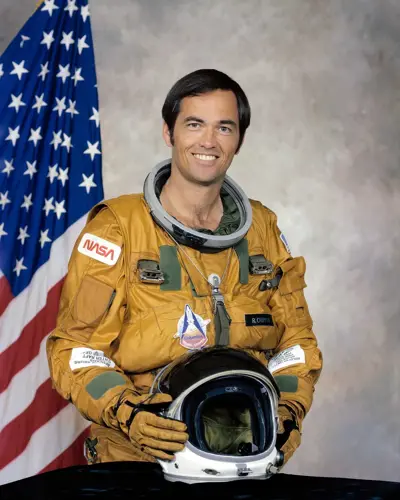
Robert Laurel Crippen is an American retired naval officer and aviator, test pilot, aerospace engineer, and retired astronaut. He traveled into space four times: as Pilot of STS-1 in April 1981, the first Space Shuttle mission; and as Commander of STS-7 in June 1983, STS-41-C in April 1984, and STS-41-G in October 1984. He was also a part of the Manned Orbiting Laboratory, Skylab Medical Experiment Altitude Test, Apollo–Soyuz, and the Approach and Landing Tests for the Space Shuttle. He did not go to space for any of those programs.
