Rafik Hariri Quotes
We want to see Israel withdraw from our territory. But we don't want to be accountable vis-a-vis Israel on the security basis, because we don't see, in the absence of a peace agreement, that Lebanon can really be accountable to Israel if anything happens.
Hariri, Rafik. Interview by Brent Sadler. CNN News, Cable News Network, 4 Sept. 2000.


Despite the fact that there were no formal political polls at the time, public opinion was very influential in curtailing what might be a tendency to use of the American military. Starting with the Cold War later, Presidents tended to use American military force regardless of public opinion or would exaggerate or lie (Vietnam and Iraq wars for example) to temporally gain some public support.


A minority of Jewish Israelis do not recognize the United Nations 1949 partition boundaries of the land creating modern Israel. They believe that God gave all the land to the Jewish people—as described in the Bible. Therefore, to them, the West Bank is a part of Israel. No Israeli government has ever maintained that position. However some governments which depend on settler and ultra-Orthodox support do not publicly disavow the position. Palestinians, look with alarm, on this view and the constant attempts at encroachment on West Bank land that the settlers attempt. Like the extremist Palestinians who want to sabotage any two-state solution, there is a minority of Israelis who do the same. These two groups made the peace process very difficult as their adherents are not only very passionate about their views, but have political influence out of proportion to their relatively small number of voters.


The Palestinians were split between supporters of Hamas and Fatah. The former was a terrorist organization which refused to recognize the right of Israel to exist and whose charter called for the killing of all Jews. The latter, accepted the right of Israel to exist and was committed to peace and coexistence with the Jewish state. They had fought a civil war and Hamas controlled Gaza with well over 1 million people which they seized for force and killed of forced out Fatah Representatives. Fatah was the elected ruling party of the West Bank, the larger and more populous of the Palestinian territories. There was little chance of any peace given that split. However, Israel which had undergone over 7000 rockets fired upon them by Hamas, stated that they refused to negotiate with the Palestinians as long as the Hamas terrorists were a part of the control of the potential Palestinian state. They would only discuss a 2 state solution if Hamas agreed that they accepted the right of Israel to exist in their general territory as a Jewish State, Hamas would accept and follow previous agreements made with the Palestinians, and Hamas would give up terrorism and the objective of killing Jews. So either Hamas would have to change its policies or Israel would negotiate with an organization that claimed it would never accept the existence of that country as a Jewish state. Al-Masri thought that the agreement he had mediated, was a necessary first step and was constructive for all the parties.


Hamas, a terrorist group, however had taken over the Gaza Strip by force, ousting the Fatah Palestinian government. Hamas were then the de facto dictatorial rulers of almost 2 million Palestinians while the Fatah Government controls the West Bank with most of the Palestinians.

”Palestine” to the Arabs of the area meant the territory of the West Bank, Gaza, and Israel itself. They wanted to expel the Jews and or take over the whole area as a single state—Palestine—with an Arab majority. With the Israeli Defense Forces successes under Dayan, this notion of Palestine was “finished”. The notion of a Palestinian State which included the West Bank and Gaza but not Israel was then negotiated and these negotiations were ongoing for years. Minorities of Arabs and Israelis did not want to see a any Palestinian state that did not include Israel proper, and they blocked it whenever they could.


He was Defense Minister at the time. This theme was picked up later by both Israel and the United States and after September 11, President George W. Bush made it official U. S. policy.
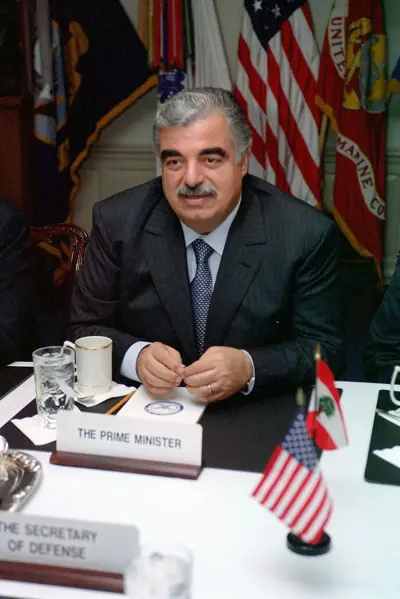
Rafic Bahaa El Deen Al Hariri was a Lebanese business tycoon and politician who served as the Prime Minister of Lebanon from 1992 to 1998 and again from 2000 until his resignation on 20 October 2004 (2004-10-20).
