Friedrich Engels Quotes
We have come to the point where a new machine invented in England deprives millions of Chinese workers of their livelihood within a year's time.
Friedrich Engels, 1820-1895, German Socialist & Revolutionary Theorist, The Principles of Communism, 1847
Sourced by: Eigen's Political and Historical Quotations

See {43974} for a succinct statement of the objections.


Technology has always displaced and replaced workers, but most industrial technological breakthroughs, in the long run, have created new jobs and better paid ones. What worried Gompers did not appear to materialize in his lifetime, but actually became and issue on the later years of the 20th century and the early 21st century where the computer the robot, and the sophisticated software began to replace workers at a faster rate than new opportunities were created. Gompers was one of the harbingers of things to come.


Many free-traders disagree. While there is unemployment in the auto industry from imported cars, there is increased employment in the importing process, the marketing, selling, and maintenance of the imported cars as well as their financing. Further, when trade is open, we can then export products and services to Japan and this creates jobs. No one has ever been able to exactly measure the jobs created so it is an unsettled intellectual economic and political question. However, the people who lose jobs to imports are generally identifiable while the beneficiaries of many of the new jobs created by open trade are never specifically identified, so public opinion is more sympathetic to the former.


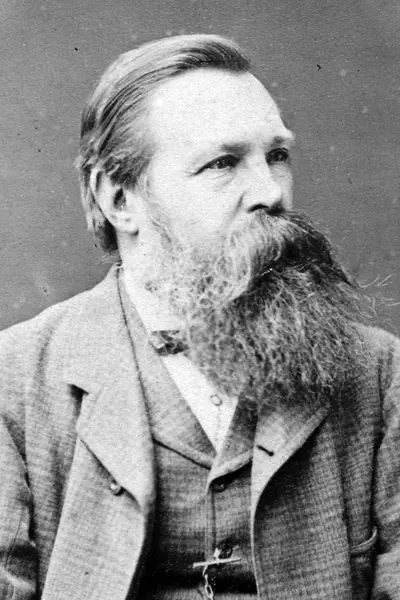
Friedrich Engels (/ˈɛŋ(ɡ)əlz/ ENG-(g)əlz, German: [ˈfʁiːdʁɪç ˈʔɛŋl̩s]), sometimes anglicised as Frederick Engels, was a German philosopher, economist, historian, political theorist and revolutionary socialist. He was also a businessman, journalist and political activist, whose father was an owner of large textile factories in Salford (Lancashire, England) and Barmen, Prussia (now Wuppertal, Germany).
