Reuven Rivlin Quotes
We cannot keep the Jewish state without being a democratic state.
Weymouth, Lally. "An Interview with Israeli President Reuven Rivlin." The Washington Post, 8 Aug. 2014.


Prior to 1948 and the establishment of the state of Israel, there were large number of Jewish refugees who were stateless and, regardless of whatever moral rights they may have had, there was no politi.cal mechanism to enforce or claim these rights. For example, in 1956 Nassar expelled most of the Egyptian Jewish population. It was only the existence of Israel that gave these people the right to come to Israel and not depend on the good will of the world to help them as refugees. The difficulty for most refugees is that there is no state to demand, support, and enforce their rights.

Since the foundation of the State of Israel in 1949, there has been compulsory military service for all except the ultra-orthodox. Initially, this was only a small handful of religious scholars, but the number had swelled to almost 70,000 man of draft age who were very vocal and active about how the nation should be run and its foreign policy but never had to risk their own lives of that of their children in fighting Israel’s wars. Finally, majority sentiment became overwhelming and the exemption was removed. The Degel HaTorah party was an ultra-orthodox Jewish minor religious party whose view of a Jewish State was very similar to the ultra-orthodox Muslims who believed that holy books of their religion are the only valid laws and must supersede everything else like man-made Constitutions or laws. For them there was NO separation between church and state. For Gafni, therefore, if a court ruling or law conflicted with the Torah (the first 5 books of the Old Testament – The Law of Moses-- it contravened the notion of a Jewish State. The vast majority of Israeli Jews believed that the civil law must trump anyone’s particular interpretation of the Law of Moses as interpreted by the ultra-orthodox or anyone else. See {636124} for another instance where Gafni complained that Israel was no longer a Jewish State.


The President was referring to the fact that most Arab governments constantly attacked Israel with an end of “wiping them off the face of the map” or “pushing them into the sea.” When Palestine was partitioned into Jewish and Arab states, the Israelis developed their part into a modern industrial democracy with the highest standard of living and political freedom in the Middle East despite having to fight off repeated Arab attacks who resented the fact that non-Arabs controlled any land of the area and that their dictatorships and monarchies were always embarrassed by the success of this “foreign” and “European” force in their midst.

The recommendation for partition was the basis of the decision of the United Nations in 1949 to partition Palestine.


This is the first statement of a Jewish nation since Biblical Times.


The murder to which he was referring was the Israeli Prime Minister Yitzhak Rabin. He had been very active in trying to negotiate a peace treaty with the Palestinians. A minority of right wing, religious fundamentalists were opposed to any peace treaty that would give the Palestinians control over the land that the fundamentalists believed was given to the Jews by God. Israel’s political system was so fractionated with minority parties having so much influence that Rabin was the only leader on the horizon who was influential and powerful enough to transcend the party politics, Since his assassination the peace process has been stalled, and the murder paid off.
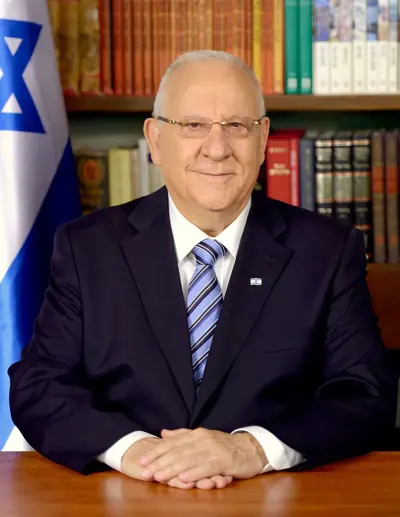
Reuven "Ruvi" Rivlin is an Israeli politician and lawyer who is serving as the current president of Israel since 2014. He is a member of the Likud party. Rivlin was Minister of Communications from 2001 to 2003, and subsequently served as Speaker of the Knesset from 2003 to 2006 and 2009 to 2013. On 10 June 2014, he was elected President of Israel.
