Tim Wise Quotes
Violating the 4th Amendment guarantees against illegal searches and seizures is not the way to solve crime problems.
Wise, Tim. Speaking Treason Fluently: Anti-Racist Reflections From an Angry White Male. Soft Skull Press, 2008.


Many politicians were arguing that giving the intelligence agencies more power to wiretap, bug and hack into personal communications despite the 4th Amendment’s strictures argued that the public was in rational fear of terror attacks and had a right to be protected.

Unfortunately there has been a history in America of some overzealous police officers and prosecutors who have gone after particular people for reasons of prejudice, politics, self aggrandisement, or honest but erroneous belief of guilt. The 4th Amendment has acted as wall in many cases, but unfortunately it is a wall that can be scaled by over zealous officials who will falsify their applications for warrants. Though not a total barrier to abuse, the 4th Amendment has been one of the major reasons that Amercans enjoy greater freedom that exists in other countries.


The choice is usually contrasted between guilty persons going free, rather an innocent one be adjudicated guilty. But here the justice tells us that the avoidance of an innocent person being subject to easy arrest is important enough to have a system where guilty people sometimes escape justice.

Gates believed that ideally the government would have the trust of the people to access critical data, but that at the moment there are many who do not trust the government. Unfortunately, the FBI on many occasions have themselves broken the law and targeted people who had political and social viewpoints of which the FBI leadership did not approve. The CIA has on many occasions violated the law and repeatedly lied to Congress and even Presidents. The National Security Agency has also, in its zeal to carry out its mission skirted the law and the Director of National Intelligence blatantly deceived Congress and was exposed by the Snowden releases. Gates was an optimist and thought that the government could regain the necessary trust to allow it to have access to virtually all data in order to best protect society from things like terrorism with biological weapons.


The FBI had obtained a court order requiring apple to write software that could hack into a person's iPhone. Apple, with most other hi-tech companies in support, filed a motion with the court opposing the order. The FBI shortly thereafter withdrew its request for the order saying that they had found other solutions, when they had originally told the court that there were no other solutions.
The FBI had obtained a court order requiring apple to write software that could hack into a person's iPhone. Apple, with most other hi-tech companies in support, filed a motion with the court opposing the order. The FBI shortly thereafter withdrew its request for the order saying that they had found other solutions, when they had originally told the court that there were no other solutions.


The FBI had obtained a court order requiring apple to write software that could hack into a person's iPhone. Apple, with most other hi-tech companies in support, filed a motion with the court opposing the order. The FBI shortly thereafter withdrew its request for the order saying that they had found other solutions, when they had originally told the court that there were no other solutions. The issue however was and remains a very difficult political, moral, ethical, and legal conundrum.

This statement was made in response to the leaked disclosure that the U. S. Security agencies had software which would allow them to turn Smart TV Sets into listing devices without ever physically touching the TV set—for that matter from any place in the world. This area wgere there was a wide range of poarized scholarly legal opinion. The view here in articulated by Comey was that in a nation, Law enforcment personnel and authorities. albeit with checks and court supervision. must be able to override all comes to and rights of privacy in order to enforce the law. The other view is that from the earliest days of our nation there were certain areas of privacy that may not be breached. Much of the debate in over 200 year has been about the checks and balances that are associated with why the provacy needs to be breached and the due process thereof. But especially with the changes in technology iver the last centuries, the other side that it is not merely the issue of due process, When brain scanning technology is developed can there be any possiuble leagal justificaion to forcing a person to be brain scanned to determine is real rellings about his wife or children, Can privacy of individual thoughts be subject to a search warrant as is speech or action? More and more legal s holars have moved away from Comey's position becasue of the ver poor pewrformance that law enforcement has had in being checked. If the chances of a FISA Court ever denying a warrant is less thatn the odds of being struck by lightening, is there really any meaningful surveilance in our current systems. In addtion to the hundreds of throusands of State and local police department and investigator scandals that have been revealed in teh last 50 years, the FBI, The CIA, Military Inteligence Agencies and the NSA -- all of whom have been exposed for violating the laws about illegal searches and siezures, lying to the Courts and to the Congressional Oversight Commitees and even to a number of Presidents, has shifted the thinking of some to regulate by providing absolute limits on abridging certain kinds of privacy like brain scanning, statements of religioully protected concessions, spousal privilege etc.


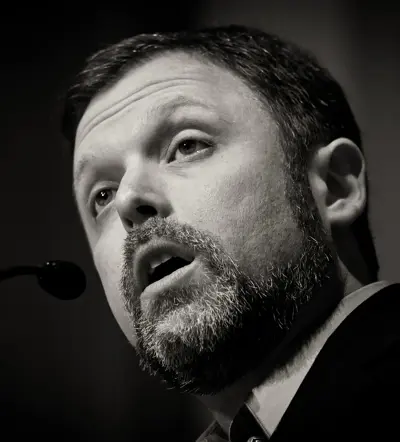
Timothy Jacob Wise is an American activist and writer on the topic of race. Since 1995, he has given speeches at over 600 college campuses across the U.S. He has trained teachers, corporate employees, non-profit organizations and law enforcement officers in methods for addressing and dismantling racism in their institutions.
