Ernest Hemingway Quotes
Until the dead are buried they change somewhat in appearance each day. The color change in Caucasian races is from white to yellow, to yellow-green, to black. If left long enough in the heat the flesh comes to resemble coal-tar, especially where it has been broken or torn, and it has quite a visible tarlike iridescence. The dead grow larger each day until sometimes they become quite too big for their uniforms, filling these until they seem blown tight enough to burst. The individual members may increase in girth to an unbelievable extent and faces fill as taut and globular as balloons.
Hemingway, Ernest. "A Natural History of the Dead." Death in the Afternoon, Charles Scribner's Sons, 1932.


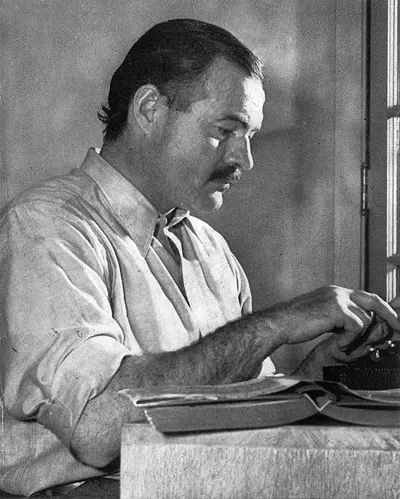
Ernest Miller Hemingway was an American novelist, short-story writer, journalist, and sportsman. His economical and understated style—which he termed the iceberg theory—had a strong influence on 20th-century fiction, while his adventurous lifestyle and his public image brought him admiration from later generations. Hemingway produced most of his work between the mid-1920s and the mid-1950s, and he was awarded the Nobel Prize in Literature in 1954. He published seven novels, six short-story collections, and two nonfiction works. Three of his novels, four short-story collections, and three nonfiction works were published posthumously. Many of his works are considered classics of American literature.
