Peter Singer Quotes
Typically, defenders of experiments on animals do not deny that animals suffer. They cannot deny the animals' suffering, because they need to stress the similarities between humans and other animals in order to claim that their experiments may have some relevance for human purposes. The experimenter who forces rats to choose between starvation and electric shock to see if they develop ulcers (which they do) does so because the rat has a nervous system very similar to a human being's, and presumably feels an electric shock in a similar way.
Singer, Peter. Animal Liberation. Harper Perennial, 2009, p. 27.


At the time there were some religious extremists who interfered with important research as they did not believe that man should try and do what before only God could do. In modern times the religious interference in scientific research has tended to be about research involving contraception, abortion or embryonic stem cell research. The most dangerous by the 21st century were the PETA and other “animal rights” terrorist groups who not only physically sabotaged some scientific research but harmed people and endangered human life in the process. Most scientists however were not intimidated and lived up to their ethical obligation to continue scientific research despite the danger of the terrorists.

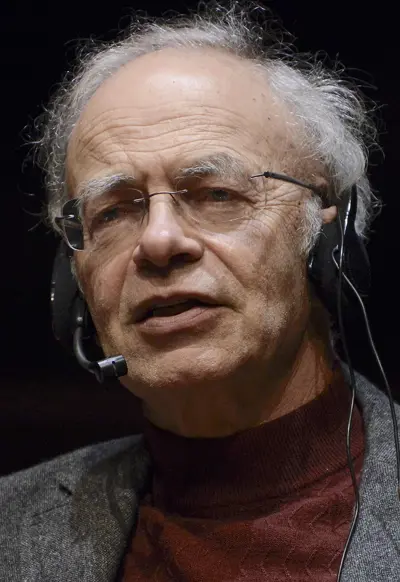
Peter Albert David Singer AC is an Australian moral philosopher, currently the Ira W. DeCamp Professor of Bioethics at Princeton University. He specialises in applied ethics and approaches ethical issues from a secular, utilitarian perspective. He is known in particular for his book Animal Liberation (1975), in which he argues in favour of veganism, and his essay "Famine, Affluence, and Morality", in which he argues in favour of donating to help the global poor. For most of his career, he was a preference utilitarian, but he stated in The Point of View of the Universe (2014), coauthored with Katarzyna de Lazari-Radek, that he had become a hedonistic utilitarian.
