Joan of Arc Quotes
Truly, if you were to tear me limb from limb and separate my soul from my body, I would not say anything more. If I did say anything, afterwards I would always declare that you made me say it by force!
Joan of Arc. The Trial of Joan of Arc. Translated by Daniel Hobbins, Harvard University Press, 2005, p. 151.


The congressman was frustrated with the Federal Reserve Board Chairman who did not provide the congressman with as much information as he wished.


It should be noted that at the beginning of the manual the reader is told that force is illegal. Then later, the manual tells the interrogator that headquarters approval is required for torture of use of chemicals. And still later there are instructions such as this quotation {597792}.
The George W. Bush administration had issued a memorandum to key Federal Agencies stating that certain types of torture were legal—a finding that was quickly repudiated after Bush and VP Cheney—who was a leading force for allowing torture of terrorism suspects—were out of office. But Bush had told the American People and the World that the United States will not torture any prisoners. The dilemma was “solved” when someone came up with this euphemism.


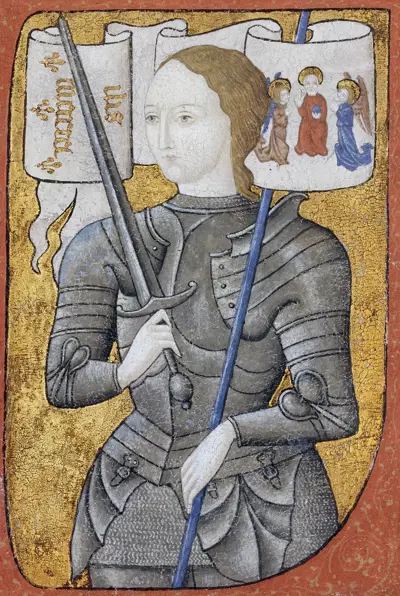
Joan of Arc, nicknamed "The Maid of Orléans" (French: La Pucelle d'Orléans) or "Maid of Lorraine" (French: La Pucelle de Lorraine), is considered a heroine of France for her role during the Lancastrian phase of the Hundred Years' War, and was canonized as a saint. She was born to Jacques d'Arc and Isabelle Romée, a peasant family, at Domrémy in the Vosges of northeast France. Joan said that she received visions of the archangel Michael, Saint Margaret, and Saint Catherine of Alexandria instructing her to support Charles VII and recover France from English domination late in the Hundred Years' War. The as-yet-unanointed King Charles VII sent Joan to the siege of Orléans as part of a relief army. She gained prominence after the siege was lifted only nine days later. Several additional swift victories led to Charles VII's consecration at Reims. This long-awaited event boosted French morale and paved the way for the final French victory at Castillon in 1453.
