Karl Marx Quotes
To be radical is to grasp things by the root.
Marx, Karl. "A Contribution to the Critique of Hegel's Philosophy of Right: Introduction." Marx & Engels Collected Works, Vol. 3, International Publishers, 1975, p. 182.


In an earlier article {606185} Maltz castigated the left-wing orthodoxy and political correctness of the time. Then he was convinced that if left-wing authors could write whatever they wanted, with no political discipline, it would mean the end of the left-wing cultural movement. Ironically, it was Maltz’s critics who were wrong in that extrapolation. With American freedom of expression, there developed a thriving left-wing cultural movement as well as a movement for almost any conceivable political viewpoint. Maltz, however, had been talked out of his own correct insights.

The great scientist is almost always a radical thinker. Politicians are rarely radical thinkers and generally distrust anyone who is. This has always produced some friction between the great scientists and the great (and not so great) politicians.


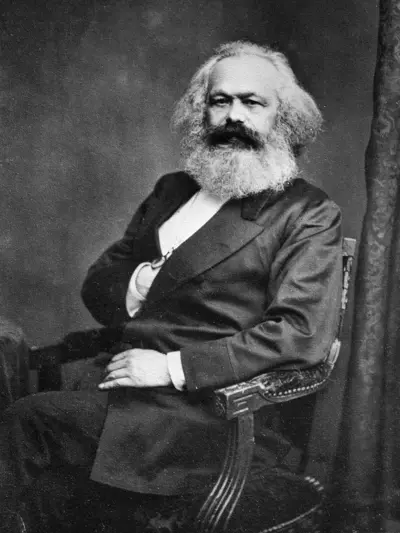
Karl Heinrich Marx was a German philosopher, economist, historian, sociologist, political theorist, journalist and socialist revolutionary. Born in Trier, Germany, Marx studied law and philosophy at university. He married Jenny von Westphalen in 1843. Due to his political publications, Marx became stateless and lived in exile with his wife and children in London for decades, where he continued to develop his thought in collaboration with German thinker Friedrich Engels and publish his writings, researching in the reading room of the British Museum. His best-known titles are the 1848 pamphlet The Communist Manifesto and the three-volume Das Kapital (1867–1883). Marx's political and philosophical thought had enormous influence on subsequent intellectual, economic and political history. His name has been used as an adjective, a noun, and a school of social theory.
