Noam Chomsky Quotes
Those are possibilities for technology, which don't tend to be used, because of the way power is concentrated. There are all kinds of possibilities, including for coercion. In China, technology is used to control and coerce. Here too, to an extent, but not to that extent.
Chomsky, Noam. Optimism over Despair: On Capitalism, Empire, and Social Change. Haymarket Books, 2017.


The war in Europe had ended in victory and the British people were looking for a better standard of living after their wartime privation. Churchill represented the class system, the Empire, and bellicose leadership and didn’t temper his approach to the peace that he had won. He made this blunder and associated the Labor Party and their social welfare state with a coming Gestapo—the name of the Nazi secret police. It was all over the top and the Conservative Party was trounced at the polls. He would be elected Prime Minister a decade later.

He was referring to the power of the United States in cyber to hack into the computers, e-mail and phones of foreign leaders. Many other americans wouod argue that a more imoiortant reason to consuct this kind of surveiulance was to obtain warnings about dangers to America and/or Americans abroad. Still ohters wold agree with Atone but unlike Sone who feels that this is morally and politically wrong, they think that there is noting wrong with us using our power to promote the Amercian agenda. There has always been a part of America that was evengelical for the free democracy with civil rights protected even from government that America uniquely developed. And then there are some American wold be imperialists. This is an issue on which Americans have desagreed since our founding.


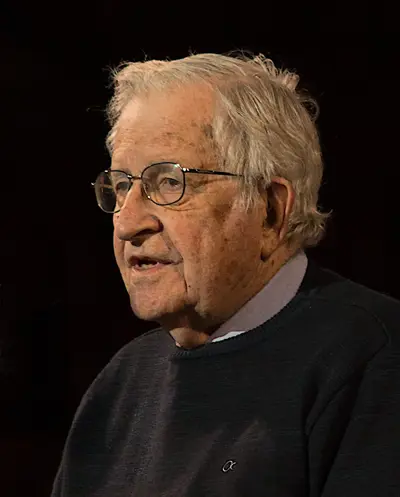
Avram Noam Chomsky is an American linguist, philosopher, cognitive scientist, historian, social critic, and political activist. Sometimes called "the father of modern linguistics", Chomsky is also a major figure in analytic philosophy and one of the founders of the field of cognitive science. He is Laureate Professor of Linguistics at the University of Arizona and Institute Professor Emeritus at the Massachusetts Institute of Technology (MIT), and is the author of more than 150 books on topics such as linguistics, war, politics, and mass media. Ideologically, he aligns with anarcho-syndicalism and libertarian socialism.
