Enuga Sreenivasulu Reddy Quotes
This public movement against apartheid is a precious heritage of the world,. It was a struggle in which ordinary people, the grassroots, were able to counteract powerful interests and to force governments to change their policies – even to defeat governments which were unresponsive. A study of this movement is important for an understanding of the dynamics and power of nonviolent public action at local, national and international levels. The anti-apartheid or solidarity movement was composed of thousands of groups in many countries and communities, many of them in opposition to the policies of their governments. They were not centrally directed. Each group was independent and acted in the light of conditions in its own country or constituency. There was no coordination – except that at various conferences (for instance, those organized by the United Nations), groups from different countries were able to meet each other, exchange views, and possibly plan international campaigns.
Enuga Sreenivasulu Reddy, Indian national & Principal secretary for the United Nations Special Committee Against Apartheid, United Nations Assistant Secretary-General, Speech, University of Connecticut under the auspices of UNESCO Chair and Institute of Comparative Human Rights, April 8, 2004
Sourced by: Eigen's Political and Historical Quotations


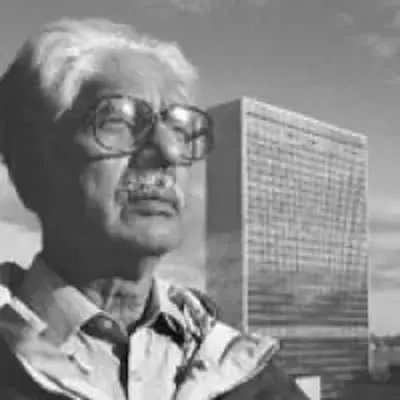
Enuga Sreenivasulu Reddy, also known as E. S. Reddy, was an Indian-born diplomat at the United Nations who led the anti-apartheid efforts at the UN's Special Committee against Apartheid (where he was the secretary from 1963 to 1965) and its Centre against Apartheid (where he was the director from 1976 to 1983). He also served as director of the UN Trust Fund for South Africa and the Educational and Training Programme for Southern Africa. During his time in these roles, he campaigned for economic boycott of the then Government of South Africa, advancing anti-apartheid actions including a combination of economic and social measures. He also lobbied for the release of the imprisoned leader Nelson Mandela.
