Tom Steyer Quotes
This is not a time for “patience” — Donald Trump is not fit for office. It is evident that there is zero reason to believe “he can be a good president.” Whether by the nature of Mr. Trump’s relationship with Vladimir Putin and Russia, his willingness to exploit the office of the Presidency for his personal gain and treat the government like a family enterprise, his conduct during Charlottesville, his decision to pull out of the Paris climate accords, or his seeming determination to take the nation to war, he has violated the Constitution, the office of the Presidency, and the trust of the public. He is a clear and present danger to the United States of America.... Given Trump’s total lack of fitness for office, the question of impeachment becomes a very real issue ....There is no moral reason to remain silent about this. Constitutional experts ... have already laid out clear legal and historical foundations for impeachment. Founding Father Alexander Hamilton, a co-author of the Federalist Papers — and an immigrant himself — argued that “high crimes and misdemeanors” could be defined as “abuse or violation of some public trust.” This president has clearly already exceeded these standards. Congress has impeached past presidents for far less.
Steyer, Tom. "An Open Letter to Elected Officials." Need to Impeach, 19 Oct. 2017.


The original proposal made treason and bribery the only grounds for Presidential impeachment. Mason and others argued to broaden the grounds and finally they agreed on “high crimes and misdemeanors.”

President George W. Bush, to justify the invasion of Iraq had told the public that the Iraqi regime was developing nuclear weapons and other weapons of mass destruction, and had participated in the September 11 attack on the United States by assisting Al Qaeda. It turned out that these statements were false. The administration claimed that their error was well intentioned and the result of faulty intelligence. Opponents claimed that the administration officials knew that they were exaggerating and had pressured the intelligence agencies to create intelligence conclusions that supported their story.


The debate was about the unlimited pardon power of the President. Madison argued that the check was the impeachment power. However, Presidents had tended to make large numbers of pardons just before they leave office so the impeachment power works only as a check for the beginning and middle part of their term.

George W. Bush had told the country that the reason for the Iraq War was that Iraq had developed weapons of mass destruction. After the invasion it was determined that there were no such weapons that had justified the war. Debate since has concentrated in whether the Bush administration had pressured the intelligence experts to provide the information they wanted to justify the war or whether the administration was misled by their intelligence agencies.

President George W. Bush, to justify the invasion of Iraq had told the public that the Iraqi regime was developing nuclear weapons and other weapons of mass destruction, and had participated in the September 11 attack on the United States by assisting Al Qaeda. It turned out that these statements were false. The administration claimed that their error was well intentioned and the result of faulty intelligence. Opponents claimed that the administration officials knew that they were exaggerating and had pressured the intelligence agencies to create intelligence conclusions that supported their story.

The United States government had for many years deposited all its funds in a single private bank, the Bank of the United States. In 1833, President Andrew Jackson, without any congressional authorization, ordered the federal deposits to be distributed among state banks instead. The Senate was furious and passed the first resolution of censure of a President in United States history:. Carried by a vote of 26 to 20. Four years later a pro-Jackson Senate majority voted to expunge the resolution.
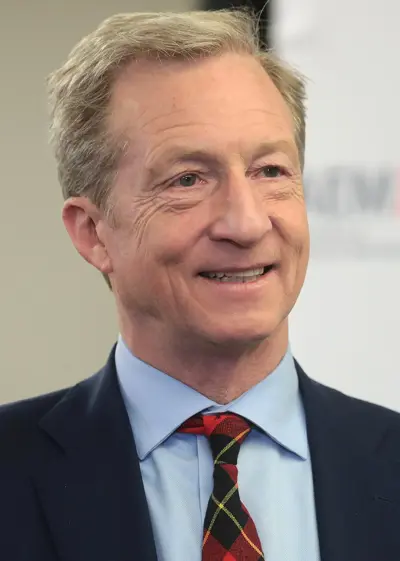
Thomas Fahr Steyer is an American businessman, hedge fund manager, philanthropist, environmentalist, and liberal activist. Steyer is the founder and former co-senior-managing-partner of Farallon Capital and the co-founder of OneCalifornia Bank, which became (through merger) Beneficial State Bank, an Oakland-based community development bank. Farallon Capital manages $20 billion in capital for institutions and high-net-worth individuals. The firm's institutional investors include college endowments and foundations. Steyer served on the board of trustees at Stanford University from 2007 to 2017. Since 1986, he has been a partner and member of the executive committee at Hellman & Friedman, a San Francisco–based private equity firm.
