Howard Dean Quotes
This is an administration that has gotten 600 Americans killed by not telling the truth. I don’t see why anyone would believe any of the political ads.
Howard Dean, Governor of Vermont (Democrat), Physician, Unsuccessful Candidate for the Democratic Presidential Nomination, Description to the administration of George W. Bush, Interview, CNN Late Edition, April 4, 2004
Sourced by: Eigen's Political and Historical Quotations

He was referring to the George W. Bush and his behavior on the Iraq War.


See {618460} for the kinds of statements that stimulated this type of political attack.

Alsop, a political hawk was convinced, as many other right wingers were at the time that the Russians had forged ahead of us in offensive missiles. When he asked President Eisenhower, the President never denied it, but never went to Congress to ask for more money to close the “missile gap”. Alsop made this shocking accusation which offended many Americans, but pleased the ultra-hawks and anti-communists. Most of the nation however then believed that there was a missile gap, with varying explanations of Eisenhower’s silence on the matter. Two years later John F. Kennedy, used the “missile gap” when running in 1960 against Nixon by attacking Nixon and Eisenhower for allowing us to fall behind the Russians at have a missile gap. When Kennedy became President, he was very surprised that there was no missile gap favoring the Russians—it was favoring the United States. Eisenhower did not want the Russians to know that he knew exactly what they were producing and deploying in missiles through great espionage sources. By not saying anything in the face of the accusations, the Russians assumed that the Americans really thought that they had more capacity than they did. And Eisenhower wanted that so that they would be secure that the United States had no real knowledge of their missile capacity. If Eisenhower had actually told the nation that the Russians were really behind us, the Russians would suspect a security leak and our sources could be compromised.


President George W. Bush, to justify the invasion of Iraq had told the public that the Iraqi regime was developing nuclear weapons and other weapons of mass destruction, and had participated in the September 11 attack on the United States by assisting Al Qaeda. It turned out that these statements were false. The administration claimed that their error was well intentioned and the result of faulty intelligence. Opponents claimed that the administration officials knew that they were exaggerating and had pressured the intelligence agencies to create intelligence conclusions that supported their story.

The facts given by the administration to justify the preemptive invasion of Iraq turned out to be wrong. Moore who is usually not very circumspect in his accusations delicately used the term “misled” as the major debate became one or whether 1) the wrong intelligence was given to the President and his administration and they unknowingly used and reported the false information to the public. 2) the uncertainty of the intelligence accuracy and the contrary evidence was given to the administration which had a predisposition to believe one scenario and the deluded themselves and our allies and the public. 3) The decision to invade Iraq was made with full knowledge that the intelligence was wrong in some areas and weak in others and some administration members pressured the intelligence agencies to make the kind of assessment they administration wanted. “Misled” covers all 3 possibilities.

In 2002, President George W. Bush, determined to invade Iraq and bring democracy to the Muslim Middle East, reported that Iraq had stockpiles of weapons of mass destruction and were very close to a nuclear bomb. They had even used biological weapons against Iran and the Kurdish minority in Iraq. The president claimed that the evidence was incontrovertible and removed those generals who questioned the wisdom of an Iraq invasion and besmirched the character and patriotism of those civilian officials and figures who questioned the evidence or its sources. After the invasion, it turned out that there were not only no stockpiles of WMD but there was no capability to manufacture WMD as had existed before the Gulf War. Bush claimed he was misled by the CIA and other intelligence operatives. It turned out that the Vice President and other administration officials only examined the intelligence which supported their justification for war.


If a government can classify embarrassing information, then it does not have to lie which is why over-classification is so prevalent. But then the officials have to lie in the classification process by claiming national security is involved as opposed to their own or their party’s security from embarrassment. Most officials prefer to tell the truth and not deceive the public. However, a large proportion have their moral instincts compromised by confusing the national interest with the politicians’ interest

This quotation is a good example of how tolerant some nations can be in terms of maintaining diplomatic relations and trade relations with other countries. The American and English governments chose to simply protest and condemn the slanderous statement but decided that the Prime Minister was pandering to his political local Islamic base, so took no further action and kept open diplomatic relations. Mahathir had a history of being very accusatory of the West with respect to anything that affected the Arab Muslims. The number of Muslims killed by the Americans and British in the Iraq War was very small compared to the huge number of Muslims killed by other Muslims in their Sunni Shiite civil war. While Bush and Blair both generated support for the Iraq invasion by making claims of WMD development in Iraq that were false, it is not clear whether or not they knew their statements were false, should have known that they were false, created an atmosphere against Iraq that was likely to produce false accusations, or were simple misled by poor intelligence. Mahathir, of course, chose to assume the worst case, and claim it was true, which is what many people think Bush and Blair did in analyzing the intelligence on Iraq.


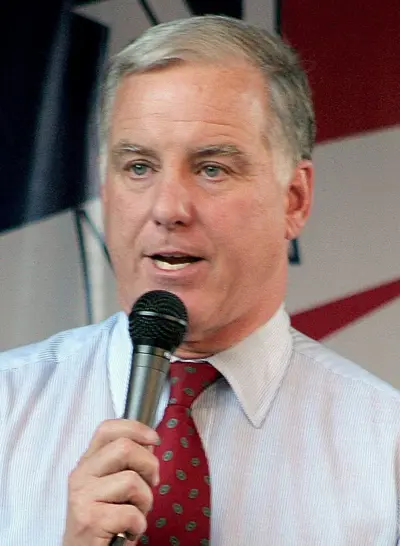
Howard Brush Dean III is an American physician, author, lobbyist, and retired politician who served as Governor of Vermont from 1991 to 2003 and Chair of the Democratic National Committee (DNC) from 2005 to 2009. Dean was a candidate for the Democratic nomination in the 2004 presidential election. His implementation of the fifty-state strategy as head of the DNC is credited with the Democratic victories in the 2006 and 2008 elections. Afterward, he became a political commentator and consultant to McKenna Long & Aldridge, a law and lobbying firm.
