Fyodor Dostoevsky Quotes
They were like two enemies in love with one another.
Dostoevsky, Fyodor. The Brothers Karamazov. Translated by Richard Pevear and Larissa Volokhonsky, Farrar, Straus and Giroux, 1990, p. 191.


A talented, charismatic leader, Alcibiades, was deposed by a religiously conservative faction in Athens who condemned him as a heretic to the God Mercury. Alcibiades escaped to the arch enemy, Sparta, where he was welcomed and became a leader there until he had an affair with the Spartan King’s wife. He then worked for the Persians, enemies of all Greeks, and finally was welcomed back to Athens where he was again made a military leader.


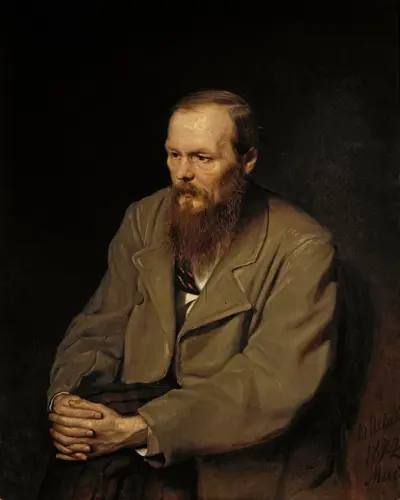
Fyodor Mikhailovich Dostoevsky, sometimes transliterated as Dostoyevsky, was a Russian novelist, philosopher, short story writer, essayist, and journalist. Dostoevsky's literary works explore human psychology in the troubled political, social, and spiritual atmospheres of 19th-century Russia, and engage with a variety of philosophical and religious themes. His most acclaimed works include Crime and Punishment (1866), The Idiot (1869), Demons (1872), and The Brothers Karamazov (1880). Dostoevsky's body of works consists of 12 novels, four novellas, 16 short stories, and numerous other works. Many literary critics rate him as one of the greatest psychological novelists in world literature. His 1864 novel Notes from Underground is considered to be one of the first works of existentialist literature.
