Paul Krugman Quotes
These days, however, the main problem comes from the right - from conservatives who, unlike most economists, really do think that the free market is always right - to such an extent that they refuse to believe even the most overwhelming scientific evidence if it seems to suggest a justification for government action.
Krugman, Paul. The Conscience of a Liberal. W. W. Norton & Company, 2007, p. 195.


Goldwater was the Republican Nominee for President and Kilpatrick a Journalist & Columnist. Both were leading conservatives of their time.

The mantra was not heard much after the collapse of the ‘smart’ markets in 2008 and the ‘dumb’ governments had to come to the rescue of the economy all over the industrialized world.

in the Meltdown of 2008 Gramm was one of the most ideological deregulators in Congress. As the Meltdown of 2008 hit, he immediately made this statement when few people even knew the extent of what had happened, much less why it happened. Gramm’s instant absolution of deregulation as one of the causes is a classic case of denial. There were few economic issues of controversy that did not contribute to the totality of causes. And a few years later Gramm was one of the very few ideologues who still believed that deregulation did not have a role in the Meltdown and the Great Recession that followed. For a contrast from the expert in his own party, see {638023}.


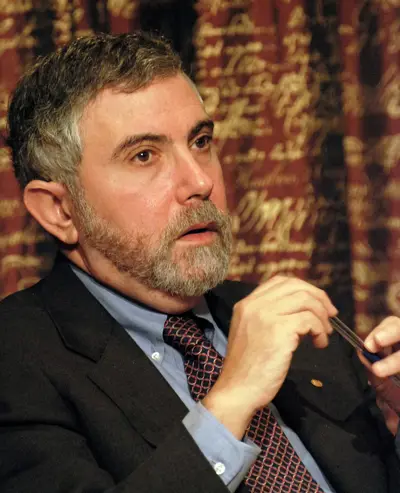
Paul Robin Krugman is an American economist who is the Distinguished Professor of Economics at the Graduate Center of the City University of New York, and a columnist for The New York Times. In 2008, Krugman was awarded the Nobel Memorial Prize in Economic Sciences for his contributions to New Trade Theory and New Economic Geography. The Prize Committee cited Krugman's work explaining the patterns of international trade and the geographic distribution of economic activity, by examining the effects of economies of scale and of consumer preferences for diverse goods and services.
