Harry Bridges Quotes
There will always be a place for us somewhere, somehow, as long as we see to it that working people fight for everything they have, everything they hope to get, for dignity, equality, democracy, to oppose war and to bring to the world a better life.
Bridges, Harry. "President's Farewell Address." Proceedings of the 22nd Biennial Convention of the International Longshoremen's and Warehousemen's Union, ILWU, 1977.


This very important historical quotations did not derive its importance for its content or the eloquence of the language. It is famous for what it triggered the examination of the role of the press that followed. His speech was at a Russian Sponsored "Peace Conference" and the Associated Press (AP) reported extensively on the role of the most prominent American participating in the conference. Exactly how it happened of why is still a mystery, but AP immediately sent back a wire story from Paris that quoted Robeson of having said, "We colonial peoples have contributed to the building of the United States and are determined to share its wealth. We denounce the policy of the United States government which is similar to Hitler and Goebbels.... It is unthinkable that American Negros would go to war on behalf of those who have oppressed us for generations against the Soviet Union which in one generation has lifted our people to full human dignity." This version was reprinted all over the United States and when a few weeks later, Robeson was to have given a concert for a civil right cause, at the instigation of a local newspaper in Peekskill NY motivated by the erroneous AP story triggered a riot where thugs beat concert goers and prevented Robson from singing that evening. See {583346} for the editorial and background. Bad reporting and irresponsible editorializing had triggered a terrible incident that at least luckily did not kill anyone.


Despite opposition of the dominant Communist Party, she had been elected 7 times in a row. She was one of the few non-communist deputies.


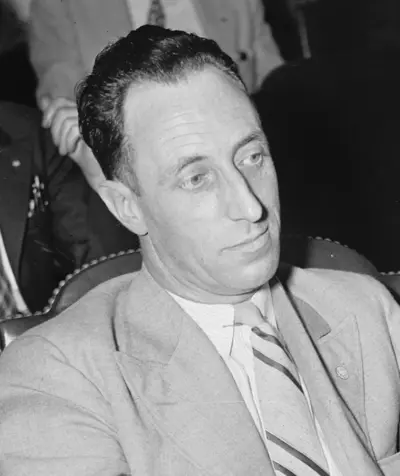
Harry Bridges was an Australian-born American union leader, first with the International Longshoremen's Association (ILA). In 1937, he led several chapters in forming a new union, the International Longshore and Warehouse Union (ILWU), expanding members to workers in warehouses, and led it for the next 40 years. He was prosecuted for his labor organizing and believed subversive status by the U.S. government during the 1930s, 1940s, and 1950s, with the goal of deportation. This was never achieved.
