Noam Chomsky Quotes
There is still much debate about whether torture has been effective in eliciting information - the assumption being, apparently, that if it is effective, then it may be justified.
Chomsky, Noam. Because We Say So. City Lights Publishers, 2015.


During that period some terrorists were handed over to Saudi Arabian and Egyptian authorities for interrogation. These countries had no qualms about torture. Goss never answered the question about that practice.

Major Fleener had been assigned to defend accused terrorists who were being held at the military prison in Guantanamo, Cuba. For several years they were held without a hearing or trial. Then the U. S. Supreme Court ruled that they had to be given a hearing or trial. A Military tribunal was selected. The methods and procedures of these hearings came under much public world-wide criticism as they did not meet the normal legal standards of most countries. Surprisingly, one of the military officers made public statements criticizing the army and the trials.


There were however several instances of torture being used. The administration used the term “enhanced interrogation” for waterboarding and other acts that the US has previously punished Americans for using. The George W. Bush administration actually had a team of their lawyers in the Justice Department write a memo to uniquely define torture so as not to include the torture techniques that were used as “enhanced interrogation”.

Chelsea Elizabeth Manning

This was untrue. The CIA used several forms of torture on high value detainees. The torture was psychological and physical. Even the FBI had agents who observed CIA interrogations and complained to their supervisors. For cover, the George W. Bush administration, got 3 Justice Department Attorneys to write a secret memo defining certain types of torture as “enhanced interrogation”. Water Boarding, for which American soldiers had been court martialed and convicted for torture then became enhanced interrogation, and was used on a few terrorists. Because of the rigged Justice Department memo, the CIA claimed that they did not torture people. Another thing the CIA did was to turn over enemy to the intelligence services of third countries like Egypt, where torture was used commonly with no regard for the Geneva convention or other human rights provision. CIA agents then watched and asked questions but they claimed that they did not torture which was in some sense literally true.

Critics of CIA methods asked whether Mr. Hayden believes that males who are also opposed to the CIA’s “enhanced interrogation” and torture base their judgment on emotion and feeling are those adjectives reserved for female critics?

Several American soldiers have been court marshalled and found guilty of illegal torture for Warterboarding prisoners to induce them to provide information. Most experts agree that intelligence received this way is highly unreliable in that victims will say anything they think the torturer wants to hear to get the torture to stop.

See {642427} for a case where the United States was accused of not living up to this treaty.

He was arguing that even if torture might provide useful intelligence not otherwise obtainable, it is not necessary in order for us to succeed in our objectives. Ironically, the military interrogation rules prohibited torture in conformity with US law and treaties but the CIA ignored those restrictions and secretly tortured a number of victims in the War on Terror until their actions became public and they too were required, by executive order to follow the military interrogation guidelines.
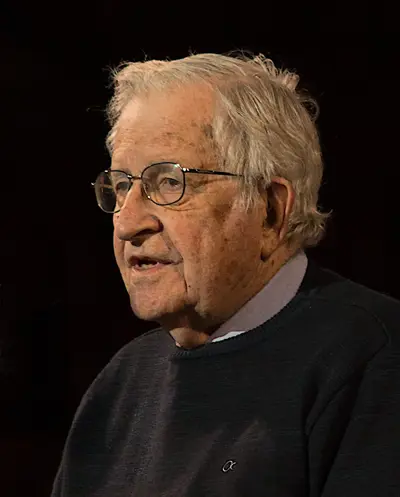
Avram Noam Chomsky is an American linguist, philosopher, cognitive scientist, historian, social critic, and political activist. Sometimes called "the father of modern linguistics", Chomsky is also a major figure in analytic philosophy and one of the founders of the field of cognitive science. He is Laureate Professor of Linguistics at the University of Arizona and Institute Professor Emeritus at the Massachusetts Institute of Technology (MIT), and is the author of more than 150 books on topics such as linguistics, war, politics, and mass media. Ideologically, he aligns with anarcho-syndicalism and libertarian socialism.
