James Buchanan Quotes
There is nothing stable but Heaven and the Constitution.
Buchanan, James. The Works of James Buchanan: Comprising His Speeches, State Papers, and Private Correspondence, edited by John Bassett Moore, vol. 11, J.B. Lippincott Company, 1911.


This is an excellent statement of one of the fundamental principles of many Christian Religious Philosophers.

Huckabee, a fundamentalist Christian Minister in addition to being a politician, had been very tolerant of other religions and their rights. However, on the abortion question he seemed to be calling for a Constitutional amendment to make abortion illegal. The likelihood of passing such a Constitutional Amendment given the supermajority requirement was very low given the national division on this polarizing issue. A very careful reading of the candidate’s statement shows that he never literally advocated an amendment. He just stated that is would be easier to change the Constitution than to change the world of God which to believers was immutable. Thus his statement was true, yet some interpreted it as a very clever way of making a moral statement without committing to a course of action that would deny women the right to make decisions over the use and risks to their own bodies, souls, and lives.


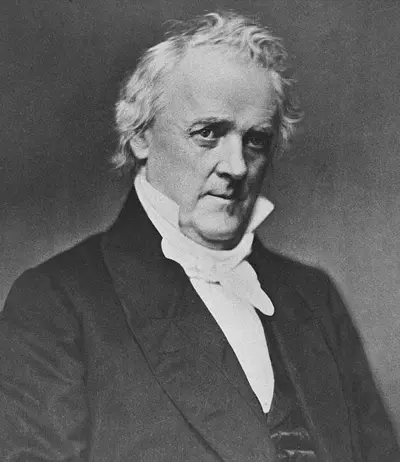
James Buchanan, Jr. was the 15th President of the United States (1857–61), serving immediately prior to the American Civil War. He represented Pennsylvania in the United States House of Representatives and later the Senate, then served as Minister to Russia under President Andrew Jackson. He was named Secretary of State under President James K. Polk, and as of 2016[update] is the last former Secretary of State to serve as President of the United States. After Buchanan turned down an offer to sit on the Supreme Court, President Franklin Pierce appointed him Ambassador to the United Kingdom, in which capacity he helped draft the Ostend Manifesto.; James McGill Buchanan, Jr. was an American economist known for his work on public choice theory (included in his most famous work The Calculus of Consent), for which he received the Nobel Memorial Prize in 1986. Buchanan's work initiated research on how politicians' and bureaucrats' self-interest, utility maximization and other non-wealth maximizing considerations affect their decision making. He was a member of the Board of Advisors of The Independent Institute, a member (and for a time the President) of the Mont Pelerin Society, a Distinguished Senior Fellow of the Cato Institute, and professor at George Mason University.
