John Calvin Quotes
There is no work, however vile or sordid, that does not glisten before God.
Calvin, John. Institutes of the Christian Religion. Edited by John T. McNeill, translated by Ford Lewis Battles, vol. 1, Westminster Press, 1960, p. 725.


Joseph Alois Ratzinger. His predecessor, John Paul II, had shown no antipathy and had seen no conflict between religion and the concept of evolution. Benedict, was more traditional and particularly sensitive to the randomness of mutations in the process. Other theologians see no contradiction in God having created the evolutionary system with random mutation as the most superior system for developing rational man to whom he gave free will. Others see no need for God in the entire process.


Bahaullah, the Bahai founder, sent letters to the Queen and most of the other major rulers of the world. Only Victoria responded positively. The Bahai believe that as a result Victoria, who came to the throne when most Englishmen felt that she would be the last British monarch, went on to rule for more than 60 years, the longest in history. All the other recipients who ignored their letter including Napoleon, the Pope, the Czar—all came to a relatively rapid end of their reign. Many Bahai believe this was divine will at work.


In 1877 Wasburn was dropped from the List of Ministers by the Unitarian Church. He had become quite atheistic.

It is you who have called us unto this office; but being thus called we have our authority from God;
Then the Deputy Governor, Winthrop had been attacked as being too authoritarian. The conceptual struggle with democracy, divine right, and religion had begun in America long before the American Revolution. There is an interesting parallel with the current debate over Islamic attacks on democracy by an Islamic party being elected, but then responsible to God and not only the people who elected them.


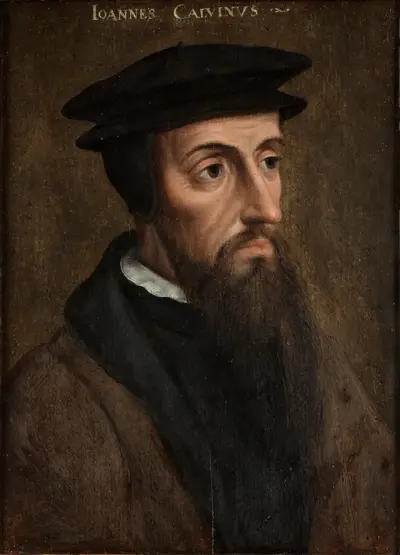
John Calvin was a French theologian, pastor and reformer in Geneva during the Protestant Reformation. He was a principal figure in the development of the system of Christian theology later called Calvinism, aspects of which include the doctrines of predestination and of the absolute sovereignty of God in salvation of the human soul from death and eternal damnation, in which doctrines Calvin was influenced by and elaborated upon the Augustinian and other Christian traditions. Various Congregational, Reformed and Presbyterian churches, which look to Calvin as the chief expositor of their beliefs, have spread throughout the world.
