Joseph W. Martin Jr. Quotes
There is no room in the government of the United States for any who prefer the Communistic system.
Joseph W. Martin Jr., 1884-1968, U. S. Congressman (Republican, MA), Speaker of the House, My First Fifty Years in Politics
Sourced by: Eigen's Political and Historical Quotations

This quotation was obtained via an FBI wiretap on Dr. King’s telephone. What makes it historically important is that J. Edgar Hoover’s FBI steadfastly maintained that King and his movement were philosophically communist in their reports to the President and others. For example, a CIA memo of the time reported that “According to the FBI, Dr. King is regarded in Communist circles as a genuine Marxist-Leninist who is following the Marxist-Leninist Line.” However, Hoover had this and other evidence of King’s antipathy to communism but suppressed this leading the administration and others to believe that the Civil Rights Movement, to which Hoover was unalterably opposed, was Communist influenced. See {603873}, {603891}, {603872}, and {603889} showing Hoover’s view of King and Blacks.

The Red Scare had already reached most conservatives and Truman and most others had not yet been affected by the fear of Communism that so many people had through the 1970s.


After the Truman defeat of Republican candidate Thomas Dewey in 1948, Republicans were searching for ways to overcome the poor image that they had with many Americans, and one of the then preeminent advertising companies was assigned the task of analyzing the 1948 failure and making recommendations. This quotation comes from that report. This recommendation defined the Republican approach for the next decades.


Cuba was not Communist under Castro in the Russian style of Communism. However, Castro operated Cuba with many of the key Marxist & Leninist Communist Principles {636672} (some of which the Russians were hypocritical about). Cuba was very much a Marxist, Socialistic State with few of the democratic reforms that characterized European Socialism. Until the collapse of the Soviet Union, Russian Communist aid propped up the Cuban economy, and that was another motivation for Castro not to criticize Russian Communism so he often appeared to be in agreement with Russian Communism even when he wasn't.


In the 1970s both England and America had a red scare here some ultra conservatives actually feared that their populations would adopt and vote for communism. The intelligence was so bad that the more the Soviet Union was financially and politically collapsing, the more they were feared.

The president was surprised by the rapid spread and expansion of the anti-war movement at the time was convinced that the communists were organizing the effort. After all the investigations and histories, it was an extremely fast growing movement—perhaps the first of the digital political movements as e-mail was one of the tools used in the universities where e-mail was then coming into use.


Immediately after the Russian Revolution, the provisional government appointed him as Ambassador to the United States. However, the provisional government was supplanted when the Bolsheviks took over. Not enamored of Communism, he stayed in the United States with many other Russian refugees.

3rd Earl Russell of Kingston. Ironically he was regarded as a socialist by most people. His view of socialism however was what evolved as European Democratic Socialism and not the “dictatorship or the proletariat” type of Communist Socialism.
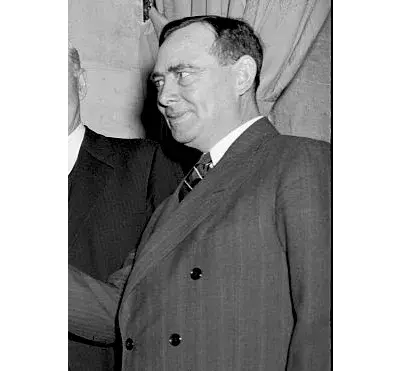
Joseph William Martin Jr. was an American politician who served as the 44th Speaker of the United States House of Representatives from 1947 to 1949 and 1953 to 1955; he represented the district covering North Attleborough, Massachusetts. He was the only Republican to serve as Speaker in a sixty-four year period from 1931 to 1995. He was a "compassionate conservative" who opposed the New Deal and supported the conservative coalition of Republicans and southern Democrats.
