Patrick O'Brian Quotes
There is a systematic flocci-nauci-nihili-pilification of all other aspects of existence that angers me.
O'Brian, Patrick. Master and Commander. W.W. Norton & Company, 1990.


As Secretary of State, Powell was going to address the UN Security Council on the 5th and he was coordinating his speech with the other agencies of the government. His criterion was that he only wanted to make accusations that were backed up by incontrovertible evidence. However, VP Richard Cheney and his aide, Scooter Libby, kept inserting an accusation that Iraq was involved with and supported Al Qaeda. This was one of the many speculations that those who wanted to justify attacking Iraq kept using as Domestic propaganda. When Powell asked for proof or intelligence reports and none could be provided, he removed the accusation from the speech explaining why. However, at the last minute, Cheney and his staff put the accusation back in, and that triggered the quotation. Unfortunately, Powell was so busy fending off totally absurd accusations, that he accepted the CIA assurances {79468} that Iraq was developing nuclear weapons that were about to be operationalized and never heard from those who questioned the credibility of the sources for the basic accusation. Powell had great trust among the diplomats of the world then gave the United States version to the Security Council and justified our coming invasion of Iraq. But the intelligence report, despite the assurances of the CIA and the Vice President, was false and Iraq not only was not close to a nuclear weapon but he had no program at all at that time to try and develop one. Powell resigned and his credibility about the world was ruined as he was then seen as just another lying politician.

Responding to a columnist's criticism of a Defense Department project, JFK wrote across the bottom of the article:

After the military victory in Iraq, Garner was in charge of reconstruction and getting Iraqi civil servants paid. Then the President appointed Paul Bremer as the do facto Governor of Iraq. No sooner did Bremer arrive and take charge than he alienated most Iraqi and even American officials including Garner. Bremer wanted direct control of all civilian and military staff including Garner’s staff. Garner did go home, and Bremer totally controlled a difficult situation in post-war nation building of Iraq. By the end of Bremer’s tenure, the situation had deteriorated almost beyond repair.

The Parliament was paralyzed by the issue of wartime leadership when PM Neville Chamberlain failed so miserably in standing up to the Germans at Munich. The speech urging the termination of the Prime Minister’s government reminded all of the famous speech whereby Lord Protector Oliver Cromwell dismissed Parliament in 1655 (see related quote). In this case Amery had no power, but much influence as the Government fell a few days later and Winston Churchill assumed British leadership.

Johnson had no real role as Vice President in the JFK administration. He had no power as he understood it also. He urged his staff to hook up with another politician who had a brighter future. Then JFK was assassinated and Johnson was suddenly the post powerful person in the world.


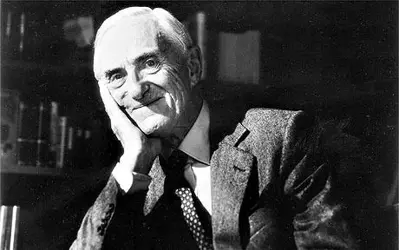
Patrick O'Brian, CBE, born Richard Patrick Russ, was an English novelist and translator, best known for his Aubrey–Maturin series of sea novels set in the Royal Navy during the Napoleonic Wars, and centred on the friendship of the English naval captain Jack Aubrey and the Irish–Catalan physician Stephen Maturin. The 20-novel series, the first of which is Master and Commander, is known for its well-researched and highly detailed portrayal of early 19th-century life, as well as its authentic and evocative language. A partially finished 21st novel in the series was published posthumously containing facing pages of handwriting and typescript.
