Martin Heidegger Quotes
There exists only one single German way of life. It is that which is rooted in the enduring core of the people and in a way of work freely offered to the will of the State, a way whose enrichment is being shaped in the National Socialist Revolution.
Martin Heidegger, 1899-1976, German Philosopher, Speech to students of the University of Freiburg, January 22, 1934
Sourced by: Eigen's Political and Historical Quotations


General Motors in Germany had started manufacturing trucks for the Nazi regime. Ford also was building dual use—military and civilian—vehicles. A number of American corporations, with World War II having started in Europe, owned subsidiaries in Nazi Germany which under Nazi laws and regulations were required to produce products for the Nazi government. IBM machines were being used to keep track of all the anti-Nazis, Jews and other perceived “enemies”. Nazi contracts were very profitable and most American firms in Germany just closed their eyes to what the Nazi regime was doing and even fired their Jewish workers rather than close down their German factories. With this horrible experience with large corporations helping what was to be our enemy, after WW2 Congress passed legislation which allows the President to make it illegal for American firms to trade with, manufacture in, or provide technical assistance to Countries that are potential enemies.


Bavaria was also the center of support and the birth of Nazism and Hitler support to drive Germany into its WWII effort just as it was the locus of aggression and militarism in WWI.

This is a very enlightening quotation. It shows how far to the right the Nazi Germany had gone. Here, the true believers, describe the notion that Jewish German citizens who had the same status as other German citizens before the Nazis took over as a “liberal position” at a time and culture where “liberal” was a great term of derision as it would become amongst conservatives in America at the beginning of the late 20th century. But in Germany it had become “liberal” to object to a minority of citizens being murdered by the state.


Although the Nazis railed against the Communists & Socialists, the potential opposition they feared the most was the middle class. See also {582967}.

This speech to over 100,000 people galvanized the Indian nationalists They had been asking the British to change the constitution to give India more independence. Churchill was opposed to any policy that would diminish the British Empire, but needed the Indians as men of India served in the British Army in every major theater of WWII. So instead of saying "No" Churchill held out the possibility but at a later time. He argued that it was inopportune to alter the Constitution in the midst of a world war.

Frau Wagner was one of several agents of Nazi Germany sent to the United States to develop good will for Germany and funds for Hitler. Anti-German feeling was still high from the First World War but America had its share of right wingers like Ford. Hitler and Ford were mutual admirers. See {586988} for Hitler’s view of Ford.

This new form of patriotism, this encouragement of pregnancy—even outside of marriage—was just too controversial. Himmler withdrew the order. It illustrates that even in a brutal dictatorship, public opinion can influence government.


He was an intellectual precursor of the Nazi movement. He was also one of Hitler's favorite authors. See {77545}.

All German Jewish Citizens were immediately disenfranchised including decorated military veterans.

There had been vicious assaults on most of the Black workers, when a few Negro welders were hired. The “compromise” was that the Negro workers would be protected from harm but there would be no Blacks in skilled positions. This was despite a huge labor shortage and a critical national need for the ships in the midst of war. Patriotism and the national crisis could not overcome the racism and hatred that existed in America. Northern newspapers pointed out the irony that America was practicing and upholding the racial theories of Hitler and the Nazis.

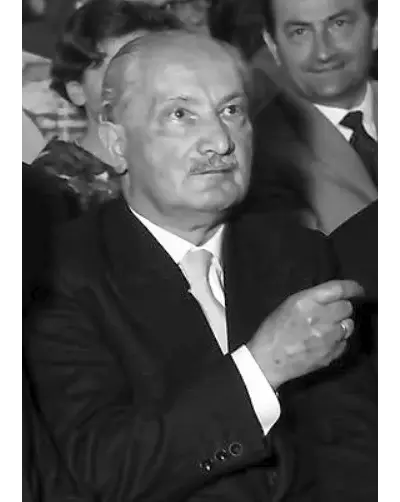
Martin Heidegger was a German philosopher who is widely regarded as one of the most important philosophers of the 20th century. He is best known for contributions to phenomenology, hermeneutics, and existentialism.
