Theodore Roosevelt Quotes
There can be no effective control of corporations while their political activity remains. To put an end to it will be neither a short nor an easy task, but it can be done ... Corporate expenditures for political purposes, and especially such expenditures by public-service corporations, have supplied one of the principal sources of corruption in our political affairs.
Roosevelt, Theodore. "The New Nationalism." 31 Aug. 1910, Osawatomie, KS. The New Nationalism, The Outlook Company, 1910, p. 17.


He made this quotation when he was a member of the Wisconsin State legislator. He was describing the influence and interaction that corporations had with the Wisconsin state legislative process.


Chomsky sees this as a problem. Many others see it as a virtue that government agencies receive current information from companies and that there is an exchange of personnel where company officials bring their experience to assist government and corporations benefit from having executives who had some government experience.

The State Department has always been reluctant to have the US Government make an official condemnation of the Turkish. Prior to the end of WWI. Turkey’s Ottoman Empire controlled most of the Middle East which was discovered to be full of oil. Armenia had no oil. The State Department since then (and until the 1970s) it has made it a top priority to advocate for Standard Oil and other American oil companies with the Turks and then the Arabs regardless of the morality of the situation. Despite the fact that virtually every American leader wanted to advocate for the Armenians, the State Department held fast to not
upset Turkey about the Armenian Genocide. Cardashian was the first American who openly stated what the real motivation was. See {638251}, {620602}, {620603}, {620604}, {620605}, and {620606}


Goldman Sachs, one of the largest worldwide financial corporation, not only spent millions on lobbyists to shape government law and regulation, but its ex-officials served on high government positions including Treasury Secretary. They also give large amounts to finance campaigns of Congressmen and other public officials who were then very sympathetic to Goldman Sachs’ welfare. There is no practical way a citizen voter can overcome that situation, especially by exercising the voting franchise.

In America and Canada, corporations, at their discretion, may leave a state/province or the country, and take their money, machines, and key people with them. The state and country lose the benefit of the employment the corporation enabled, the talent and productivity of the people who leave, and the business done by other companies in supporting the corporation. As a result corporations can not only lobby for whatever legislative outcome they want, and can give unlimited campaign contributions, but they can simply threaten to move to another state of offshore if they do not get their way. In many other nations, the corporations cannot move without permission and their assets can be frozen. Currency controls could prevent them from taking their money and running. The Freedom of the United States and Canada is well worth the risk of corporations dictating policy to government, but that is a very undesirable and undemocratic problem that must be faced in other ways

At the time this was a very widely held, bipartisan view. See {634818} . Given statements like this, TR if he were alive today would never be able to get the Republican Nomination for President; nor could he obtain the Democratic Nomination because of his view on the military, expansionism, defense spending and war.

Note the difference in standards that existed at the beginning of the 20th century. The Wall Street Journal was offended because corporations had paid agents in labor unions, legislatures and political parties. A century later it was common for corporations to have many lobbyists (overt and covert) in legislatures,. They had key representatives in political parties and gave the parties huge fiscal and service contributions and not only had their paid agents in labor unions but often sometimes paid the officers of the unions. The morality of 1904 seems almost quaint.

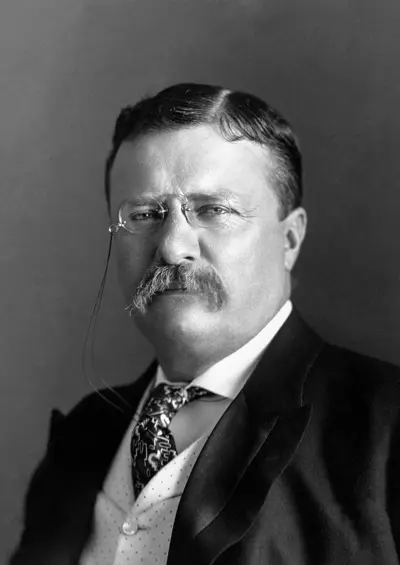
Theodore Roosevelt Jr., often referred to as Teddy or his initials T. R., was an American statesman, conservationist, naturalist, historian, and writer, who served as the 26th president of the United States from 1901 to 1909. He previously served as 33rd governor of New York from 1899 to 1900 and the 25th vice president of the United States from March to September 1901. Roosevelt emerged as a leader of the Republican Party and became a driving force for anti-trust and Progressive policies.
