Fulton J. Sheen Quotes
There are not a hundred people in America who hate the Catholic Church. There are millions of people who hate what they wrongly believe to be the Catholic Church — which is, of course, quite a different thing.
This is a very important historical quotation in that it shows the extensive degree of anti-Catholic prejudice that existed in America in the late 1930s. Most of the anti-Catholic feeling was based in the absurd but real belief of millions of Protestants that the Pope was trying to control America. Then there was the fear and that American Catholics would take political direction from the Vatican and the Catholic bishops. The perception of the Church was hundreds of years out of date. Most of the anti-Catholic bias reduced along with anti-Semitism in the remainder of the 20th century as Americans became much more religiously tolerant. By the 21st century, religious prejudice still existed but it was limited to a small group of Americans whose views were generally condemned by the American mainstream of thought and opinion.
Fulton J. Sheen, 1895–1979, Roman Catholic Archbishop, First Religious Television Evangelist, Foreword to Radio Replies Vol. 1, 1938
Sourced by: Eigen's Political and Historical Quotations

This quotation was used by the Lyndon B. Johnson 1964 Campaign as: “We represent the majority of the people in Alabama who hate niggerism, Catholicism, Judaism, and all the isms of the whole world.” So said Robert Creel of the Alabama Ku Klux Klan. He also said, “I like Barry Goldwater. He needs our help.” The second statement was made at a different time.


Poland was one of the Nazi occupied nations which cooperated in the mass murder of Jews and facilitated the Holocaust. Even after the war, much of the Polish Catholic clergy maintained virulent anti-Semitic views and in 1946 Polish thugs with the encouragement of some priests engaged in a pogrom in Kielce of returning Polish Jewish refugees. Catholic Primate of Poland, Augustus Hlond, made numerous anti-Semitic statements further exacerbating the problem. Many cast blame on Pope Pius XII who was not very vocal during the Nazi era regarding the ill treatment and murder of Jews, Gypsies, and handicapped, giving a “green light” to the Polish Prelate and those lower anti-Semitic priests. Papal apologists note that Hitler could have turned on the Catholic Church; the Pope had to walk a fine line between condemning evil and risking the welfare of the Church. Nonetheless, many Catholic priests risked and some lost their lives speaking out against the Nazi evil and protecting Nazi targets.


In this speech, and in {634756}, he argued against unification to a public that was mostly opposed. The leadership was interested because they were facing the Muslim Ottoman Turks who were getting more powerful each day. The Eastern Emperor, Constantine XI, more of a soldier and politician than a cleric, wanted the military strength of the Franks and other Western European Christian armies to help protect the Eastern Empire and Byzantium and were willing to reunite under the Pope to get it. Gennadios and his faction were not. They prevailed and the next year, the Muslims conquered Byzantium which had little help from the armies of the Western Roman Empire.


These kinds of inflammatory sermons are delivered with the approval of the king and royal family who crack down on any cleric who preaches what they do not approve of.


The Nazis did not create German anti-Semitism for the first time. Germany had a long brutal history of murder and torture. Luther was a virulent Anti-Semite. But he was not always such. See {629231} for totally contradictory writing earlier in his career. The Modern Lutheran Church does not currently follow any of Luther’s anti-Semitic dicta and has repudiated his views on murder for the glory of the religion, although many did support it in WWII. What is stunning about this quotation is that this religious leader was advocating burning houses of God, schools and people for the “glory” of God and Christianity. However all major religions had viscous and bloody pasts. Most adherents have rejected that past as being misguided, primitive and incompatible with the modern, more noble view of the religion while only a few religious extremist fundamentalist still adhere to the darker history and interpretation of the religion.


Most people are familiar with the people are familiar with the terrible persecution of the Jews in Spain by the Christians. Although there were a few examples of tolerance to Jews by Muslims when they controlled Spain and instances like modern Turkey. Generally however there is and has been Islamic persecution of Jews, Christians, and other non Muslims in almost all nations where Muslims have been in control. Until the Enlightenment, Christian persecution of other religions was just as bad if not worse.
Many Protestant Englishmen were shocked to hear this, having little familiarity with the details of the functioning of the Church of England—the Established Church of Great Britain—in Ireland and the contribution of the Church to the discrimination against Irish Catholics and the poverty of Ireland.

In the middle of 2010, this organization was running public utility bus ads in major American cities.

Througout political history, including in America, opportunistic, unscruplous politicians have appealed to the prejudices and hates of subsets of the population for others (usually minorities) to get elected or obtain support for legislation and administrative action. In America this has been an element of all populist movements—an enemy. This quote is particularly enlightening in that it shows that the real need is to have a minority to focus the public against—which one is not as material as the fact that there is one.

Odo of Chatillon-Sur-Marne. This is an amazingly distressing quotation for most moderns. Here we have the Pope preaching genocide and ethnic cleansing. This was one of the main triggers of the bloody Crusades and is not forgotten by Muslims in the Middle East Today. As Islam has not changed a great deal in 1000 years, most Muslims assume that the same is true of Christianity and especially the popes and the Roman Catholic Church. This is one of the reasons that the Islamic world reacts so strongly when a pope makes any statement negatve about Muslims and Islam.
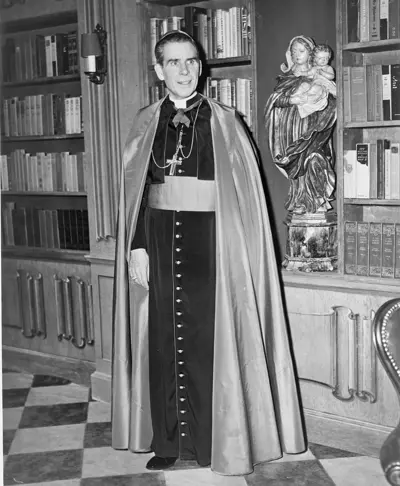
Fulton John Sheen was an American bishop (later archbishop) of the Catholic Church known for his preaching and especially his work on television and radio. Ordained a priest of the Diocese of Peoria in 1919, Sheen quickly became a renowned theologian, earning the Cardinal Mercier Prize for International Philosophy in 1923. He went on to teach theology and philosophy at the Catholic University of America as well as acting as a parish priest before being appointed Auxiliary Bishop of the Archdiocese of New York in 1951. He held this position until 1966 when he was made the Bishop of Rochester. He resigned in 1969 as his 75th birthday approached, and was made the Archbishop of the titular see of Newport, Wales.
