Noam Chomsky Quotes
There are cases - for example, the American Revolution. George Washington's army lost just about every battle with the British, who had a much better army. The war was basically won by guerrilla forces that managed to undermine the British occupation.
Chomsky, Noam. Understanding Power: The Indispensable Chomsky. Edited by Peter R. Mitchell and John Schoeffel, The New Press, 2002.


The State of Massachusetts, which was opposed to the war of 1812, withdrew its militia from Federal service and was threatening to declare itself neutral in the war.


The Army actually violated the laws of West Virginia as well as the Constitutional rights of thousands of people. The justification was that there was a labor dispute in the West Virginia mines and there had been some violence. Capt. Morgan was one of three military officers of a military court which actually took over and assumed absolute control of the strike district. They army broke many more laws than they enforced.

The treaty ending the Revolutionary war guaranteed that the English bankers and merchants who had debts going back to before the American Revo
lution would have “no impediment” in collecting their debts in America. However, Rhode Island and Virginia in particular placed many impediments and made it virtually impossible for debts to be collected in their states. The John Jay led Supreme Court, in particular, overturned state actions on the grounds that they had implemented Patrick Henry’s sentiment and hence violated the treaty.

The De Lancey family were prominent New York businessmen and politicians who were British loyalists in the American Revolution. At the end of the war the De Lancy estates were confiscated and the family went to England and Canada. Despite the unpopularity or the family, there is a major street in New York City that bears their name: De Lancy Street.


Mengustu seized power in a coup. However his Marxist Dictatorship was very unpopular and a civil war soon started. The poorly armed opposition used guerrilla warfare insurgency techniques. Since the government was hated by most people there was much support for the guerrilla in the villages and countryside. Mengustu adopted a policy of genocide as described by this chilling quotation. The areas of the country which were sympathetic to the revolutionaries were then systematically starved by the government withholding food. There was a bad agricultural crop but international donors including the United States provided much food aid. However this was withheld by the government from the areas where there was any support for the freedom fighters. Over 1 million Ethiopian citizens were starved to death. This quotation was one of the important documents that proved that there was a systematic government policy to commit genocide—in this case to “drain the sea”. After the revolution was successful, Mengustu was convicted of Crimes Against Humanity but escaped to Zimbabwe where he was given sanctuary by his fellow dictator, Robert Mugabe.
There is a technical issue of whether or not this was genocide in that the exterminated people were not of one race, religion or ethnic group, but the people who were residents of the areas which were giving “aid and comfort” to the freedom fighters.

This part of the war was particularly bloody as Marion and his opponent Colonel Tarleton both committed atrocities and war crimes against the civilians who supported the other side or tried to remain neutral. Marion was promoted to General.

The crackdown on Boston which was intended to set an example and intimidate all of the other colonies backfired, and the British were told about it by their own officials in America. But they were so rigid and ideological about monarchy, that the stimulated rebellion rather than suppress them.

Wilkes was a strong advocate for the American cause—so much so that some in Parliament tried to deny him his seat in Parliament for his disloyal point of view.

The simplistic view that the American colonists were patriots and the British were the colonizers against whom the colonists revolted is not really accurate. The American colonists were polarized into patriots and loyalists. The Loyalist Americans ranged from many of those merchants whose business depended upon England, those whose family were still in England, those whose religion made them loyal to the Church of England, slaves who would be free under British law, Americans who had strong cultural and intellectual ties to England and those Americans who were great believers in monarchy and whose honor required that they fulfill the oath that they had taken to the King of England. Some of the worst atrocities of the American Revolution occurred in the battles of these Americans against each other. See {82105} for more on this point.

Note that Britain was blockading Boston in the middle of 1775, some time before the outbreak of battles in Concord and Lexington in 1776. What Gates did not tell Lord Dartmouth, and maybe did not know himself, was that the skilled Massachusetts sailors smuggled a great deal through the blockade in small boats at night landing in the many inlets and coves in the Boston area. Also, do not think of Boston in 1775 as today. At that time most people had, in the city, their own farms and gardens and grew much of their own food. The Boston Commons was a common area for grazing sheep. So the British Blockade of Boston was not very effective.

2nd Earl of Guilford. This bill cut off all trade with the American Colonies. It was meant as pressure to cease the rebellion. It did not work.

One of the very poorly executed military maneuvers of the American Revolution was the failed patriot attempt to invade Canada and take Quebec. The Generals assigned to lead the invasion made a host of blunders. When things were not going well, they asked for Benedict Arnold to come and reinforce them. However, they asked for help too late as Arnold explained to George Washington. The reason they wanted Arnold was that at the early part of the American Revolution he was one of the two best field commanders the Patriots had. Soon after, he led the successful battle of Saratoga, but his Commander did not give him any informal or official credit. Arnold felt that he was not properly recognized for his many military achievements and that appears to be true. However, with that mental predisposition, he gave in to venal motives and went over to the British side—the only senior officer who committed treason in the Revolution.

During the American Revolution, conditions were very difficult for Washington’s soldiers who were ill armed, ill clothed, and ill fed while they were paid irregularly. At one point morale was so low that some of the soldiers revolted. Smyth observes that Washington and Congress disciplined the mutineers very mildly, especially when compared with the way the British would deal with such things. The British Governor Clinton tried to take advantage of the mutiny and the poor morale by announcing that all of Washington’s troops who wished could obtain amnesty and join the British forces where the pay and conditions were much better. Professor Smyth found it fascinating that none of the Americans would join the British and he credits it to the wise and mild discipline policies of Washington and Congress as well as the general perception of the justice of the American cause among the American troops.

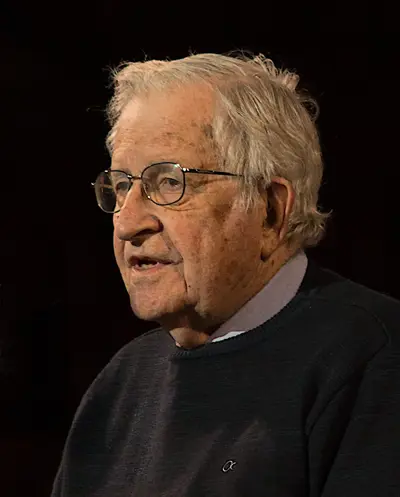
Avram Noam Chomsky is an American linguist, philosopher, cognitive scientist, historian, social critic, and political activist. Sometimes called "the father of modern linguistics", Chomsky is also a major figure in analytic philosophy and one of the founders of the field of cognitive science. He is Laureate Professor of Linguistics at the University of Arizona and Institute Professor Emeritus at the Massachusetts Institute of Technology (MIT), and is the author of more than 150 books on topics such as linguistics, war, politics, and mass media. Ideologically, he aligns with anarcho-syndicalism and libertarian socialism.
