A. P. Herbert Quotes
The wounded wailing in the sun, The dead, the dust, the flies. The flies! Oh God, the flies That soiled the sacred dead, To see them swarm from dead men's eyes And share the soldiers' bread ., Nor think I now forget The filth and stench of war,.
Alan Patrick Herbert, 1890-1971, British Writer & Member of Parliament, Poem about the WWI Battlefield at Gallipoli, Quoted in Between the Lines, Issue 46, Autumn 2012
Sourced by: Eigen's Political and Historical Quotations


The description was of the battle field at Bull Run. The Times even then was very candid. The public was shocked and some thought it unpatriotic to print this.

He was then a young Lieutenant.


The Philippine-American War was terribly brutal. In response to insurgent atrocities against American soldiers, some of the Americans also adopted brutal tactics including torture and mutilation. Washington had heard stories of this improper behavior in the part of some American troops and instructed the senior officers to investigate and discipline the men if the reports were true. Unfortunately some of the senior officers covered up the illegal and criminal behavior of some Americans. This quotation was taken from a New York Times report on a representative of the Red Cross who went to the Philippines at the invitation of the insurgents. He generally found serious atrocities by some of the soldiers on both sides but by no means all of the combatants. General Otis, the U. S. Commander tried to keep Blake out, and had him detained away from the battle areas for some weeks where he was “educated” about the enemy atrocities. Finally Blake got to the field and reached the insurgent commander who had invited him. His report generally praised the American troops, but spared no details when there were guilty of atrocities.


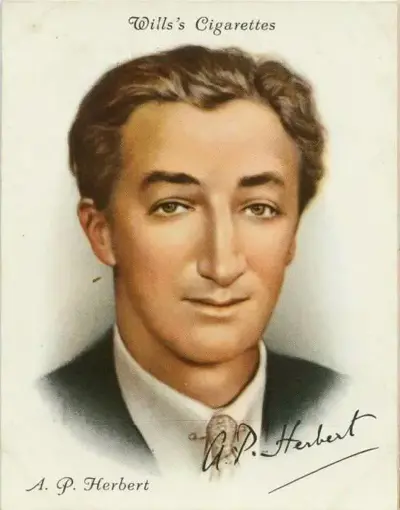
Sir Alan Patrick Herbert CH, usually known as A. P. Herbert or simply A. P. H., was an English humorist, novelist, playwright and law reform activist, and an Independent Member of Parliament for Oxford University from 1935 until 1950, when university constituencies were abolished. Born in Ashtead, Surrey, Herbert attended Winchester College and New College, Oxford, graduating with a starred first in Jurisprudence in 1914. He joined the Royal Naval Volunteer Reserve as an ordinary seaman in World War I, later serving as an officer with the Royal Naval Division. He fought in Gallipoli and on the Western Front, becoming battalion adjutant in 1917, before injury excluded him from the front line. After the war, he published The Secret Battle and joined the staff of Punch in 1924. He also wrote librettos for musicals. Elected as Independent MP for Oxford University in the 1935 general election, Herbert campaigned for private member's rights, piloted the Matrimonial Causes Act 1937 through Parliament, opposed the Entertainments Duty, and campaigned against the Oxford Group. He joined the River Emergency Service in 1938 and served in World War II as a petty officer in the Royal Naval Auxiliary Patrol. He captained his river boat, the Water Gipsy, on the River Thames. In 1943, he joined a parliamentary commission to investigate the future of the Dominion of Newfoundland.
