Carl Jung Quotes
The utter failure came at the Crucifixion in the tragic words, 'My God, my God, why hast thou forsaken me?' If you want to understand the full tragedy of those words you must realize what they meant: Christ saw that his whole life, devoted to the truth according to his best conviction, had been a terrible illusion. He had lived it to the full absolutely sincerely, he had made his honest experiment, but it was nevertheless a compensation. On the cross his mission deserted him. But because he had lived so fully and devotedly he won through to the Resurrection body.
Jung, C. G. Analytical Psychology: Notes of the Seminar Given in 1925. Edited by William McGuire, Princeton University Press, 1989.


Samuel Langhorne Clemens, 1835-1910


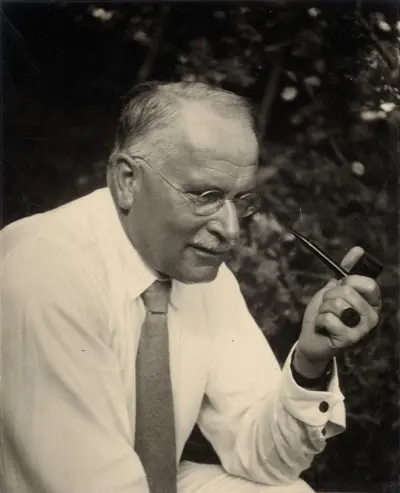
Carl Gustav Jung, was a Swiss psychiatrist and psychoanalyst who founded analytical psychology. Jung's work has been influential in the fields of psychiatry, anthropology, archaeology, literature, philosophy and religious studies. Jung worked as a research scientist at the famous Burghölzli hospital, under Eugen Bleuler. During this time, he came to the attention of Sigmund Freud, the founder of psychoanalysis. The two men conducted a lengthy correspondence and collaborated, for a while, on a joint vision of human psychology.
