Noam Chomsky Quotes
The U.S. and its allies will do anything they can to prevent authentic democracy in the Arab world.
Chomsky, Noam. Because We Say So. City Lights Books, 2015.


Assad was the autocratic ruler of Syria. In the second decade of the 21st century, a number of dissident groups started a rebellion. The Unied States and most of the EU countruies wanted to assist the rebels as Assad had been butchering his own people to put down the rebellion. Russia, in addition to having an allaince with Assad for a Navel Base in Syria, was very coincerned about the people replacing Assad if the revolution succeeded. The coalition of rebels was not at all a coalition and there was considerable fighting and hatred between them ISIS was one of the stringest groups and the Russians were worried that they might take over so they supported Assad and in 2016 actually intervened using Russian air power to support the Government troops. That turned the tide and teh rebellion was prevented from succeeding. The Russian leadership was distressed that the United States did not take their concerns seriouly enough and indeed after they were in teh fight, the United States had to deal with them about the fate of Syria, so it was a successful tactic.


At the time our strongest allies in the Middle East were Monarchies, dictatorships, and Principalities. See {586706}
At the time our strongest allies in the Middle East were Monarchies, dictatorships, and Principalities. See {586704}.


The 40 Committee was a secret committee of officials to deal with major national security covert operations possibilities. Chile had democratically elected Salvador Allende, a strong socialist, as President. He then, as he had promised in his campaign, begun to nationalize mining and other heavy industry and nationalized the very large farms. Kissinger and some others thought that Allende might probably transform Chile to communist state. The committee was discussing whether or not the United States should, via covert operations, try and destabilize or overthrow the Allende government. There was a strong minority aristocracy of the wealthy who would definitely support such an activity. Kissinger argued for intervention and some others observed that Allende had been fairly elected as a leftist by the people. Kissinger made this famous statement, and America covertly though the CIA worked with the Chilean right wing and fascists to overthrow Allende. The military, having been given the “green light” started attacking the Presidential Palace. Allende made a radio speech to the nation. A few hours later, the military seized the palace and reported that Allende had committed suicide.
Kissinger stating that the US should “correct” the election “mistakes” of other countries was of course Top Secret and the official US position was to support the right of any people to elect their preferred leaders. Normally, the public would never have seen the transcript of the meeting until many decades had passed but part of the transcript found their way to a manuscript of a book about the CIA. That agency went to the courts to block the publication and Kissinger’s statement. However, although the quote was removed from the book, enough people had now seen it, and the quote was leaked.
The quote is historically important for the real story of what really happened in Chile as General Pinochet who seized power turned out to be guilty of Crimes Against Humanity and Allende is today a national hero and martyr. In addition, it is a wonderful example of “overclassification”. After the action was completed, why should the American Public not know that its Secretary of State did not believe in democratic elections if the people would elect communists? --especially when the official stated policy he was presenting was just the opposite. The argument faded when the Watergate Scandal broke and consumed America’s attention.
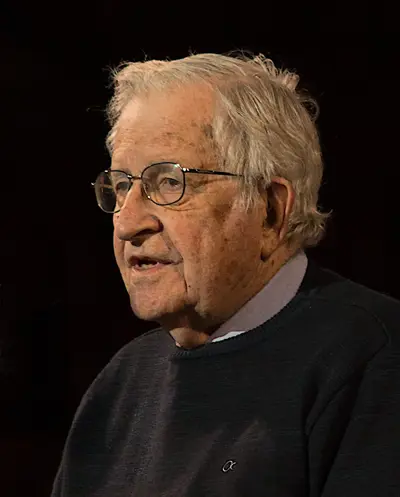
Avram Noam Chomsky is an American linguist, philosopher, cognitive scientist, historian, social critic, and political activist. Sometimes called "the father of modern linguistics", Chomsky is also a major figure in analytic philosophy and one of the founders of the field of cognitive science. He is Laureate Professor of Linguistics at the University of Arizona and Institute Professor Emeritus at the Massachusetts Institute of Technology (MIT), and is the author of more than 150 books on topics such as linguistics, war, politics, and mass media. Ideologically, he aligns with anarcho-syndicalism and libertarian socialism.
