Rumi Quotes
The undisciplined man doesn't wrong himself alone- he sets fire to the whole world.
Rumi, Jalal al-Din. The Mathnawí of Jalálu'ddín Rúmí. Translated by Reynold A. Nicholson, Vol. 1, Luzac & Co., 1926.


Newspapers and politicians of the time would sometimes whip up public opinion to a point of violence and then complain that people are violent.


The prime minister was known to have had a serious problem with alcoholism.


The Scientific Project that developed the Atomic Bomb. After the development of the atomic bomb there were great pressures on the involved scientists to downplay the dangers of nuclear weapons development. The weapons developer arm of the government was anxious not to frighten the public which might call for more oversight or even limitation of development and testing. Equally important was the scientists themselves who understood the forces that they had unleashed and were worried that if the public realized the worst of the possibilities, science and scientific research itself might be in jeopardy from a new Luddite reaction. Oppenheimer urged candor with the public. Most scientists took his advice but the Atomic Energy Commission had become politicized and when Oppenheimer went public with his and others scientific concerns they punished him by calling him a security risk and withdrawing his clearance thus cutting him off from new developments and discrediting him and his views at the same time.

Many children were born in the United State from parents who were in America without any documentation or were brought to America as a child. America is the only country they have ever known and they were being deported, along with their parents until President Obama put a stop to their deportation. The children born in the United States were citizens who were being deported until the practice stopped.


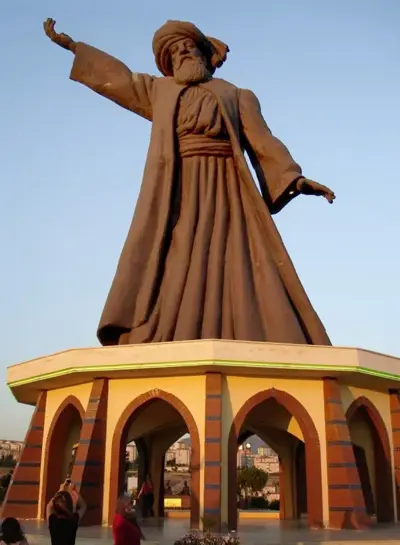
Jalāl ad-Dīn Mohammad Rūmī (Persian: جلالالدین محمد رومی), also known as Jalāl ad-Dīn Mohammad Balkhī (جلالالدین محمد بلخى), Mevlânâ/Mowlānā (مولانا, "our master"), Mevlevî/Mawlawī (مولوی, "my master"), and more popularly simply as Rumi, was a 13th-century Persian poet, Hanafi faqih, Islamic scholar, Maturidi theologian, and Sufi mystic originally from Greater Khorasan in Greater Iran. Rumi's influence transcends national borders and ethnic divisions: Iranians, Tajiks, Turks, Greeks, Pashtuns, other Central Asian Muslims, and the Muslims of the Indian subcontinent have greatly appreciated his spiritual legacy for the past seven centuries. His poems have been widely translated into many of the world's languages and transposed into various formats. Rumi has been described as the "most popular poet" and the "best selling poet" in the United States.
