J. D. Vance Quotes
The transition after the Vietnam War to an all-volunteer force created the world's finest professional military. But it also reinforced geographic and cultural divisions that reveal themselves in our voting.
Vance, J. D. "Why Trump's Antiwar Message Resonates with White America." The New York Times, 4 Apr. 2016.


This was his most famous speech.


After Roosevelt, most eras of American politics more or less followed the pattern Roosevelt described herein as a “calamity”, with the anger becoming more or less intense. Jefferson thought that these were natural divisions of politics in all societies--{604810}. The thing that masked this for years was race and slavery. In Lincoln’s time there were liberals and conservatives in both parties if race were ignored. In Theodore Roosevelt’s era, he, Taft and others were generally liberal reformers, while a large number of Republicans were conservative supporters of the status quo. Some democrats were radical reformers like William Jennings Bryan while others were arch conservatives. Until 1964 and the Civil Rights Act there were many conservatives in the Democratic Party, but almost all switched to the Republican Party in anger. The Republican conservatives tended to drive the Republican liberals out of the party and for the last part of the 20th century Roosevelt’s “calamity” well described the American political scene, and the anger increased carrying partisan bitterness into the 21st century.


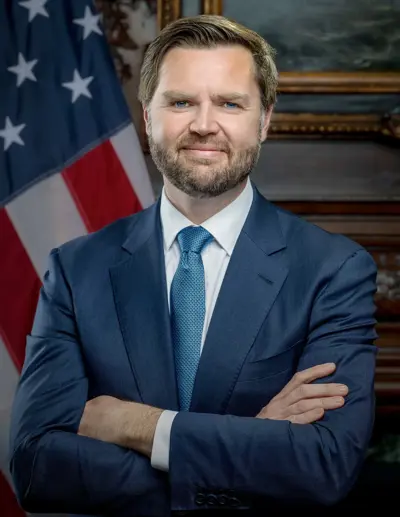
James David Vance (born James Donald Bowman; August 2, 1984) is an American politician, author, attorney, and Marine Corps veteran serving as the 50th vice president of the United States since 2025 under President Donald Trump. A member of the Republican Party, he represented Ohio in the U.S. Senate from 2023 to 2025. After high school, Vance joined the Marine Corps, where he served as a military journalist from 2003 to 2007, and was deployed to the Iraq War for six months in 2005. He graduated from Ohio State University with a bachelor's degree in 2009 and Yale Law School with a law degree in 2013. He practiced briefly as a corporate lawyer before embarking on a career in the tech industry as a venture capitalist. His memoir, Hillbilly Elegy, was published in 2016 and adapted into a film in 2020.
