Peter Singer Quotes
The traditional view of the sanctity of human life will collapse under pressure from scientific, technological, and demographic developments… it may be that only a rump of hard-core, know-nothing religious fundamentalist will defend the view that every human life, from conception to death, is sacrosanct.
Peter Singer, Ethicist, “The Sanctity of Life,” Foreign Policy September/October 2005
Sourced by: Eigen's Political and Historical Quotations


When a couple sought assistance from a fertility clinic, the best medical procedure to fertilize a few female egg cells with sperm. After a few days of development, the seemingly best embryo is selected for implantation in the mother. The others are usually frozen so that they can be used later if there is a miscarriage or the baby dies in childbirth. The Senator and a few other religious fundamentalists believe that the fertilized cell clusters are actually human beings. Therefore if there is a successful birth, the remaining ones should not be used for research using the embryonic stem cells. On the other hand, many are often discarded as most people do not see the cell clusters as a human being but as a potential human being just as a pile of bricks and a truck of cement is not a house but is a potential house if things are done properly.


Refers to issues like abortion, in-vitro fertilization, and the use of extraordinary life-extending procedures


This is a classic example of a legislator, concerned about the ethics and morality of certain types of scientific experiments, and not understanding the scientific meaning of the terms used, would also make illegal existing and important technologies and cures. In this case, he thinks of cloning as reproducing another exact human being, but we clone human cells every day to produce many of the beneficial medicines we use commonly. And the combination of animals and humans is common in many aspects of modern medicine. For burns the tissue of pigs is used to cover the wound and act as a scaffold on which human skin cells grow. There are millions of people in America and the rest of the world who are leading a normal life with a pig or a cow heart valve. There are ethical problems to be sure but most legislators have little clue as to what they are, and tend to want to outlaw whole areas of science out of their ignorance in in reaction to public pressure from others who do not understand what it is that they want to prohibit.

This was written over 2 decades before Dolly the sheep was first cloned. Since his call for a societal public discussion about cloning, there has been very little, but by the 21st century there had been just a few hasty, ill-informed, almost hysterical efforts to legislate on the subject.

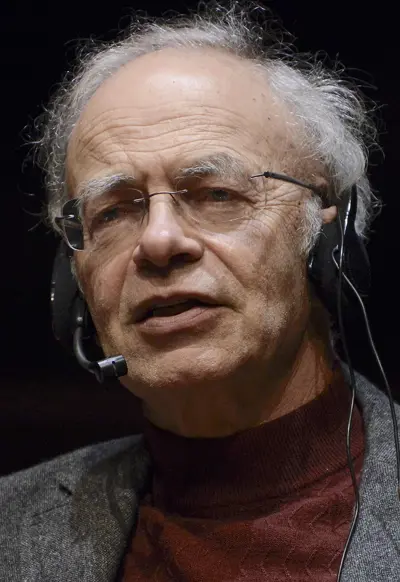
Peter Albert David Singer AC is an Australian moral philosopher, currently the Ira W. DeCamp Professor of Bioethics at Princeton University. He specialises in applied ethics and approaches ethical issues from a secular, utilitarian perspective. He is known in particular for his book Animal Liberation (1975), in which he argues in favour of veganism, and his essay "Famine, Affluence, and Morality", in which he argues in favour of donating to help the global poor. For most of his career, he was a preference utilitarian, but he stated in The Point of View of the Universe (2014), coauthored with Katarzyna de Lazari-Radek, that he had become a hedonistic utilitarian.
