Thomas Friedman Quotes
The thing you have to remember is, oil and gas are commodities, and the more we use them the more the price goes up, like any commodity. Solar, wind - they are technologies, so the more you use them, the more the price goes down.
Friedman, Thomas L. Hot, Flat, and Crowded: Why We Need a Green Revolution--and How It Can Renew America. Farrar, Straus and Giroux, 2008.

Lott, like many other reasonably intelligent people who understood little about technology, did not realize that all the early efforts with a technology are relatively primitive and even the best ideas have to be engineered to scale and cost efficiency. A decade later, solar energy had become a significant industry in the work and the United States, which had invented many of the early technologies had lost the international lead in Solar Energy to Germany and China. The ultimate value of any technology cannot be judged by the initial technological efforts.

His assertion that wind energy is less expensive than the fossil fuel alternative is not accurate if one accounts for the costs on the basis of conventional accounting methods. It was at that time more expensive which is why it’s use was limited. However, the existing methods of accounting did not charge the fossil fuels for the environmental degregation that they cause and the cost to society to overcome these or live with them. More important there is no charge to the cost of fossil fuels for the deleterious health effects that their extraction and use cause. Global warming / climate change is not considered at all in the economic analysis.


At the time this article was written coal was being phased out in most of the country but not as the result of any political actions. The new technologies of producing shale oil and fracking had driven down the price of natural gas and oil, making coal the most expensive fuel alternative so the market place was finally doing what the politicians would not do. Ironically, the conservative politicians from coal producing states like West Virginia and Kentucky, who would normally say that government should always defer to the marketplace, then called for government action to protect the coal industry from the marketplace.

See {635006} for a slightly earlier French solar engine. Much of the most effective uses of Solar power uses the concentrated heat of the sun to heat water or some other substance like this device. The vast majority of the hot water heaters in Israel function on this principle—no electricity or any other fossil fuel. The only reason that the solar engines of the time were more costly where fuel was available is that no one realized the huge environmental consequence of the fossil fuels. Today we do realize that but do not charge the oil and gas companies and consumers to cover the costs of fixing what we know about and are able to remedy. Solar powered equipment is not a modern invention however and has been with us for well over a century. Paul Collins wrote “He calculated that solar power cost about ten times as much as coal, so that until coal began to run out, solar power would not be economically feasible. But this, to him, was not a sign of failure—there was no question that fossil fuels would indeed run out someday. The great engineer maintained an unshakeable belief in the future of solar power to his last breath; he had set up a large engine in his backyard and was still perfecting it when he collapsed in early 1889. Though his doctor made him rest, Ericsson could not sleep at night: he complained that he could not stop thinking about his work yet to be done.” The only reason that the solar engines of the time were more costly where fuel was available is that no one realized the huge environmental consequence of the fossil fuels. Today we do realize that, but do not charge the oil and gas companies and therefore consumers cover the costs of fixing what we know about and are able to remedy. Solar powered equipment is not a modern invention however and has been with us for well over a century.


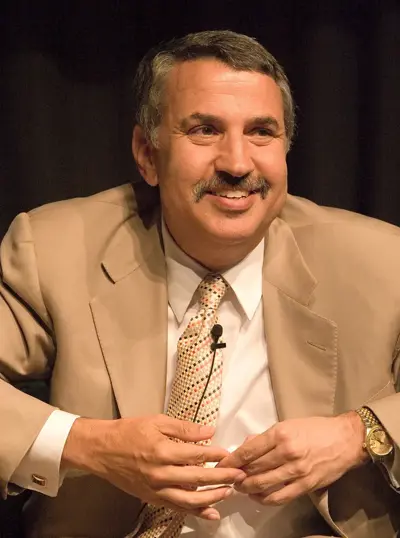
Thomas Loren Friedman is an American political commentator and author. He is a three-time Pulitzer Prize winner who is a weekly columnist for The New York Times. He has written extensively on foreign affairs, global trade, the Middle East, globalization, and environmental issues.
