Andrew Carnegie Quotes
The Republic may not give wealth or happiness; she has not promised these. It is the freedom to pursue these, not their realization, which the Declaration of Independence claims.
Andrew Carnegie, 1835-1919, Industrialist and Philanthropist, Triumphant Democracy, 1886
Sourced by: Eigen's Political and Historical Quotations


Jefferson had deliberately modified John Locke’s phrase “life, liberty and property.

The preamble to this declaration of womens’ rights cleverly beginy s with the words of the Declaration of Independence with the single change that “all men” is replaced with “all men and women.” The message was clear. If the founders had a moral right and duty to revolt for these objectives women would be justified and duty bound to make similar efforts. That message terrified many men of the era.


Jefferson and some of the other Founding Fathers saw the American experiment as having implications for the whole world. To Jefferson, the Declaration of Independence was not just for Americans but ideally for all mankind.

This was written and adopted by Vermont a decade before the United States Constitution the ideas for which were in existence in America before the Constitutional Convention in Philadelphia.

Most politicians and philosophers would argue that liberty is both an individual right and a group right. However there are money who do not recognize group rights and feel that they are inimical to individual rights.

The opening line of the North Vietnamese Declaration of Independence was a quotation of Thomas Jefferson’s in the American Declaration of Independence. What is even more interesting is that Ho Chi Minh who wrote it asked for and received help in checking his translation from an American agent of the OSS---Office of Strategic Service, precursor to the CIA. While Ho adopted much from the American Democratic concepts, he did not include free elections of multiple party candidates, freedom of speech, travel, or many other basics.

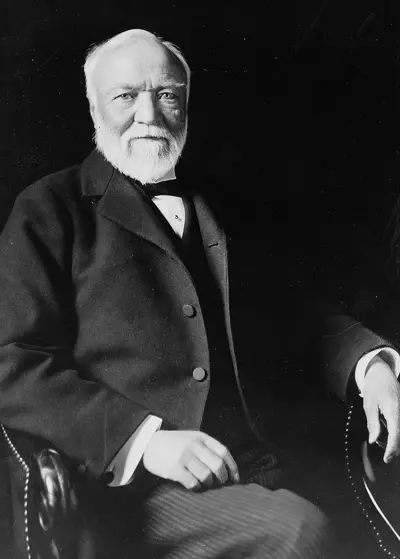
Andrew Carnegie was a Scottish-American industrialist and philanthropist. Carnegie led the expansion of the American steel industry in the late 19th century and became one of the richest Americans in history. He became a leading philanthropist in the United States and in the British Empire. During the last 18 years of his life, he gave away ~$350 million (roughly $5.2 billion in 2019) to many charities, foundations, and universities – almost 90 percent of his fortune. His 1889 article proclaiming "The Gospel of Wealth" called on the rich to use their wealth to improve society and stimulated a wave of philanthropy.
