Swami Vivekananda Quotes
The principles of the Vedanta not only should be preached everywhere in India, but also outside. Our thought must enter into the make-up of the minds of every nation, not through writings, but through persons.
Vivekananda, Swami. The Complete Works of Swami Vivekananda. Advaita Ashrama, 1989. Vol. 4, p. 370.


The inscrutability of the “oriental” was not racial as Nicholson and many others thought as most Asians who became Westernized tend to behave and respond to the Western culture in which they were brought up. However, many of the “oriental” cultures place a premium on inscrutability and avoidance of candor. Therefore, often they interact with Westerners and are unsure of the certainty of what they hear and observe. Or they hear it in ways that in their culture would not indicate strong feeling when that was intended by the Westerner. For example, Arab oratory tends to repeat something intensely felt several if not many times. A Western Diplomat who thinks he “makes himself clear” might slow down and emphasize each word distinctly—a sign of strong emphasis in Western oratory—but if only stated once or twice might not be taken as seriously meant. So communicating between cultures has often caused difficulties which people have assumed were racial characteristics but were cultural.
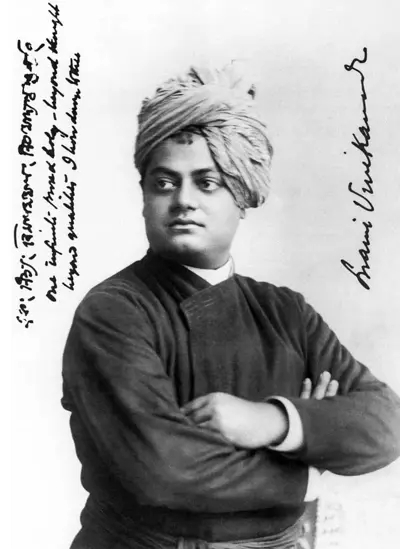
Swami Vivekananda, born Narendranath Datta (Bengali: [nɔrendronatʰ dɔto]), was an Indian Hindu monk. He was a chief disciple of the 19th-century Indian mystic Ramakrishna. He was a key figure in the introduction of the Indian philosophies of Vedanta and Yoga to the Western world, and is credited with raising interfaith awareness, bringing Hinduism to the status of a major world religion during the late 19th century. He was a major force in the contemporary Hindu reform movements in India, and contributed to the concept of nationalism in colonial India. Vivekananda founded the Ramakrishna Math and the Ramakrishna Mission. He is perhaps best known for his speech which began with the words "Sisters and brothers of America ...," in which he introduced Hinduism at the Parliament of the World's Religions in Chicago in 1893.
