Patty Judge Quotes
The people in Iowa know that Washington isn't working. It's devolved into partisan politics and a lot of gridlock and obstruction.
Noble, Jason. "Patty Judge enters Democratic race for U.S. Senate." The Des Moines Register, 4 Mar. 2016.


This quotation is very important in that Wood was one of the great political historians of early America and his judgment about the hyperpartisanship of 2012 had reached such extremes that our greatest founding fathers could not have survived in that arena.

At the time Congress was gridlocked in bitter hyperpartisan conflict. Most people called for more comity and bipartisanship and most politicians wanted more bipartisanship but blamed the other party for the rift. Mourdock, arguing for less bipartisanship and no compromise defeated Richard Lugar in the Republican Senatorial Primary election. Lugar, one of the most respected and effective Senators was a statesman who worked with any and all to find effective compromises to reach national solutions. The nation was so politically polarized that the Republican Indiana voters ousted one of their most senior senators because he was effective at developing national solutions. See {626717} and {302706} for other Mourdock’s outrageous comments. While this rhetoric won in the Primary, it lost him the general election in a state where Republicans had a strong majority and should have had the seat.

This was one of the most remarkable statements made by a Congressional leader. At the time, the Congress was in the midst of one of the worst stalemates in American Political History. The national debt limit had to be raised in order to legally pay for the expenses that the Congress had voted for and the President had approved. A minority of the House—the Tea Party--tried to use the necessary legislation to get a program of theirs legislated when they did not have the votes to pass it in both houses of Congress. The House would not approve any solution that the Senate would pass, and the Senate would not pass any of the House proposals. The Boenner and the President had reached a compromise but the minority of his own party refused to go along and threatened to oust the Speaker and not vote for the Compromise. To them, compromise was surrender and doing business as usual. At the same time, the left wing of the President’s party did not want to vote for the Compromise plan that the President and the Speaker had worked out. Then the Minority Leader of the Senate, create a new plan that would transcend solve the immediate problem and defer the larger issues which would continue to be debated. The Senate Majority Leader agreed to go along with it and so did the President, but the Minority Leader’s fellow Republicans in the House refused to vote for that compromise. The President and then Boenner went on national television sequentially to explain the situation and the Speaker made this famous quotation, Boenner, we caught in an impossible situation. His Tea Party faction insisted that there need not be a stalemate. The President and the Senate needed the debt limit raised and they would have to give in and vote for the Tea Party plan. Almost all of the Tea Party members were new to Congress and Bonner realized that an entire party who controlled the Senate would never be blackmailed that way, and even if they did, the President would Veto. Yet his own deputy was preferred by the Tea Party and some others, so if Boenner tried to act statesman like, he was risking his speakership. So he became the spokesperson of the Tea Party wing and denied what 90 percent of all Americans knew to be true. Usually absurd statements clearly contrary to the facts at the time are the results of mistakes or gaffs. Occasionally, a more complex situation explains it.


The first Jew to run for the Vice Presidency on a major party ticket.


In the early years of the Obama Administration, the minority leader of the Senate declared that the object of the Republicans in the Senate was to prevent Obama from being reelected. Therefore, the Republicans used the filibuster to block virtually all legislation. In 2010, the Republicans gained control of the House of Representatives and would not pass any legislation that the President favored lest he get credit for accomplishing something. It had gotten so bad, that even when the President proposed Republican ideas about which everyone agreed, that too was blocked.

This was one of the worst Congresses in American History and had the worst productivity record—passing very few bills, and none of any significance. The anti-government, Tea Party hyper-conservative Wing of the Republican Party intimidated the Speaker of the House and they were opposed to any compromise at all on anything.

The historian was comparing Obama to other historical presidents who either had a majority of both Houses of Congress or had an opposition party that was generally quite cooperative and willing to compromise for the sake of running the country smoothly. At this point in time there was a Tea Party wing of the Republican that was particularly negative and obstructionist. They tended to threaten and intimidate the main stream Republicans who used the filibuster to block legislation the majority of Senators had voted for more times than all the other Congresses in American history. And that was only in Obamas first 6 years.

At the time, the Republicans held the House of Representatives, but not the Senate or the Presidency. By popular vote, even the House elections had the majority voting for the Democrats, but the gerrymandering gave the Republicans more seats. A minority of the minority Republicans were Tea Party Republicans—ultra conservatives who would not compromise but who intimidated other Republicans by threatening to run candidates against them in primary elections. The result was that the Tea Party Republicans—a minority of the minority could block almost any legislation and did. That Congress passed less legislation than any in American history including the “Do Nothing Congress” of the Truman era.


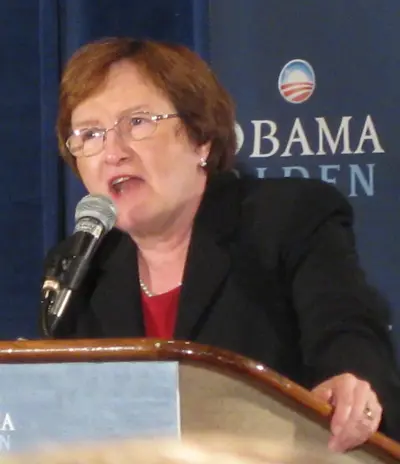
Patty Jean Poole Judge is an American politician who served as the 45th lieutenant governor of Iowa from 2007 to 2011 and previously the 13th Secretary of Agriculture of Iowa from 1999 to 2007. She unsuccessfully ran for reelection as lieutenant governor in 2010 after being elected to the office in 2006 with Chet Culver as governor.
