Antonin Scalia Quotes
The only way to eliminate any government choice on what art is worthwhile, what art isn't worthwhile, is to get the government totally out of the business of funding.
Scalia, Antonin. Concurring opinion. National Endowment for the Arts v. Finley, 524 U.S. 569, Supreme Court of the United States, 25 June 1998.


Kent’s left wing views were reasons that even his non-political works were not exhibited by many institutions and government exhibits. At the height of the Cold War, Kent had arranged an exhibit of his art to travel around the Soviet Union. However, the State Department, knowing his intention, refused to issue a passport for him to leave the country. However, they could not stop the art work from being sent or Kent from suing the Government. When the Supreme Court ruled that Kent or any other American Citizen was entitled to a passport, he traveled to Russia, caught up with his art work, and donated the exhibit, 80 paintings and many more graphics, to “The People of the Soviet Union.”
A theater arts program that operated nationally under the WPA. Some of the more politically active artists started using the projects to express their political ideas. Flanagan had promised that it would not be to Harry Hopkins who in return promised that there would be no Federal censorship of the Federal Theater. Despite their best intentions, neither of them could keep their promises.


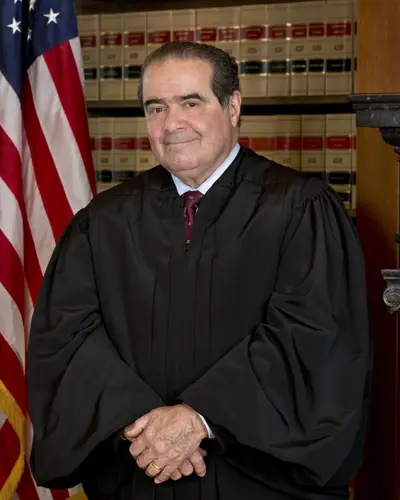
Antonin Gregory Scalia was an American jurist who served as an associate justice of the Supreme Court of the United States from 1986 until his death in 2016. He was described as the intellectual anchor for the originalist and textualist position in the Court's conservative wing. For catalyzing an originalist and textualist movement in American law, he has been described as one of the most influential jurists of the twentieth century, and one of the most important justices in the Supreme Court's history. Scalia was posthumously awarded the Presidential Medal of Freedom in 2018 by President Donald Trump, and the Antonin Scalia Law School at George Mason University was named in his honor.
