Naftali Bennett Quotes
The most important thing in the Land of Israel is to build, build, build. Its important that there will be an Israeli presence everywhere. Our principal problem is still Israels leaders unwillingness to say in a simple manner that the Land of Israel belongs to the People of Israel.
Bennett, Naftali. Speech to the Yesha Council. Israel National News, 2012.


Because of the classic historical anti-Semitism and discrimination, Jews were barred from land ownership and as a result few were farmers or had agricultural experience in their families. They were tradesmen, artisans, professionals in Europe. So amongst Jews and non Jews alike the notion of Jews settling the land of Palestine and farming it or trapping, the way the Boers had in South Africa or the French in Canada, was not a very credible image. The Zionists, realizing this potential weakness, placed strong emphasis on agriculture, developed the agricultural kibbutz concept and encouraged Jews to become farmers. The effort was so successful that almost all the leading early Zionist immigrants to Palestine became farmers. When independence came to Israel, the Jewish agriculture was more productive than most of that in Europe and almost on a par with small farms in the United States. The Israelis were known for “making the desert bloom.

Arguing that the Arabs will never agree willingly to a Jewish state:

Olmert was speaking for a significant minority of Israelis who believe that God consecrated the land of Palestine to the Jewish People and all other peoples who controlled it did so by conquest. So their logic is for those who do not believe in the Bible and give no modern credence to God’s will, the Jews have no taken back the land by conquest which is the way the Palestinians and all of the many peoples had controlled that land. For believers, the Jews have the highest right; for non-believers, their right of conquest is no weaker than any of the others.


The President was referring to the fact that most Arab governments constantly attacked Israel with an end of “wiping them off the face of the map” or “pushing them into the sea.” When Palestine was partitioned into Jewish and Arab states, the Israelis developed their part into a modern industrial democracy with the highest standard of living and political freedom in the Middle East despite having to fight off repeated Arab attacks who resented the fact that non-Arabs controlled any land of the area and that their dictatorships and monarchies were always embarrassed by the success of this “foreign” and “European” force in their midst.


Prior to 1948 and the establishment of the state of Israel, there were large number of Jewish refugees who were stateless and, regardless of whatever moral rights they may have had, there was no politi.cal mechanism to enforce or claim these rights. For example, in 1956 Nassar expelled most of the Egyptian Jewish population. It was only the existence of Israel that gave these people the right to come to Israel and not depend on the good will of the world to help them as refugees. The difficulty for most refugees is that there is no state to demand, support, and enforce their rights.


Since the foundation of the State of Israel in 1949, there has been compulsory military service for all except the ultra-orthodox. Initially, this was only a small handful of religious scholars, but the number had swelled to almost 70,000 man of draft age who were very vocal and active about how the nation should be run and its foreign policy but never had to risk their own lives of that of their children in fighting Israel’s wars. Finally, majority sentiment became overwhelming and the exemption was removed. The Degel HaTorah party was an ultra-orthodox Jewish minor religious party whose view of a Jewish State was very similar to the ultra-orthodox Muslims who believed that holy books of their religion are the only valid laws and must supersede everything else like man-made Constitutions or laws. For them there was NO separation between church and state. For Gafni, therefore, if a court ruling or law conflicted with the Torah (the first 5 books of the Old Testament – The Law of Moses-- it contravened the notion of a Jewish State. The vast majority of Israeli Jews believed that the civil law must trump anyone’s particular interpretation of the Law of Moses as interpreted by the ultra-orthodox or anyone else. See {636124} for another instance where Gafni complained that Israel was no longer a Jewish State.

The “radicals” refer to the extremely conservative, religiously-oriented Israelis. To them the only real and important element is the land that God gave to the Jewish people. They see the State as artificial and whose only legitimate role is to protect and defend the land of Israel. God has ordained the laws in the Talmud—the first 5 Books of the Old Testament. They do not believe in democracy but seek a Hebrew Theocracy of the Ancient Jews before they made the error of having kings. Some of them opposed the civil government of Israel when the country was founded via a UN resolution and a few would not even defend the new country under a civil government. The relative moderates see Israel as a nation state where the land of Israel can be changed, negotiated, traded as other nations do with their borders. One irony is no one knows exactly the borders of the land which God gave to the Jews and this is why archeology is so politically important in Israel compared to other countries.


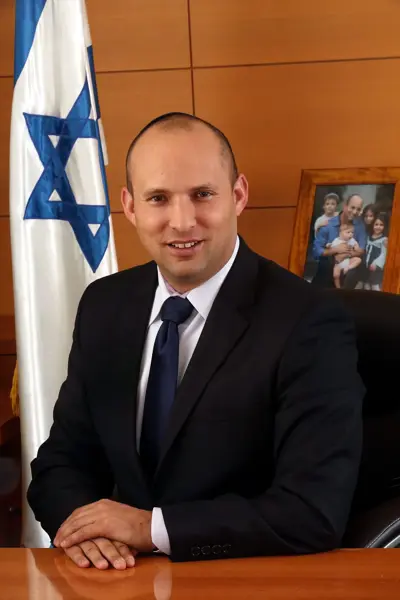
Naftali Bennett is an Israeli politician who led the Jewish Home party between 2012 and 2018 and currently serves as an MK for New Right. Between 2013 and 2015, he held the posts of Minister of Diaspora Affairs, Minister of Economy and Minister of Religious Services. From 2015 he continued as Minister of Diaspora Affairs and became Minister of Education. From 2019 to 2020 he was Minister of Defense.
