Baruch Spinoza Quotes
The more a government strives to curtail freedom of speech, the more obstinately is it resisted; not indeed by the avaricious, ... but by those whom good education, sound morality, and virtue have rendered more free.
Spinoza, Baruch. Tractatus Theologico-Politicus. Translated by R. H. M. Elwes, George Bell and Sons, 1883, p. 261, Ch. 20.

Spinoza’s ideas were considered so radical and dangerous that he was the only man in history who was excommunicated by the Catholics, the Jews and the Muslims. However, we see in Spinoza the observations and foundations of what would become American and then international views of human rights.


For example, most of the documents that are classified as secret in the CIA are so classified because the censor thought the information might be damaging to the CIA’s interest, not the American citizen’s. However, there is a strange logic that is sometimes given to justify censoring material that would embarrass the agency: If the agency is embarrassed, public support and confidence in the agency will be eroded, and that in turn will cause investigations, reviews, and possible diminished budgets. This would be distracting from the agency’s mission of keeping Americans safe, so the public should be kept in the dark about embarrassing material.


The segment to which he referred were corporations. In his view, the then existing limits on corporate contributions to political campaigns were a “muffling” of the most experienced economic operatives in our society—corporations. Therefore this was censorship of the corporation’s right to freedom of speech. So in his view, in addition to the rights that were abrogated the nation was being blocked from receiving the political voice of one of its best sources of experience and wisdom regarding economic matters. The Supreme Court with the George W. Bush appointees became much more conservative and a few years later, with Scalia leading the charge, the court overruled itself and all its precedents and decided that Corporations were entitled to free speech. See {642321} for an earlier Supreme Court view that corporations were not entitled to the protection of citizens. This Scalia statement was quoted by fellow Supreme Court justice Anthony Kennedy in one of his opinions.

The President was reacting to a chain of vents whereby Sony Entertainment produced a satiric movie which offended the leadership of North Korea who condemned, threatened and may have launched a cyberattack on Sony. That company reacted by withdrawing the movie and the President thought that was a mistake despite the fact that there were threats against theaters showing the movie and people attending the showings.


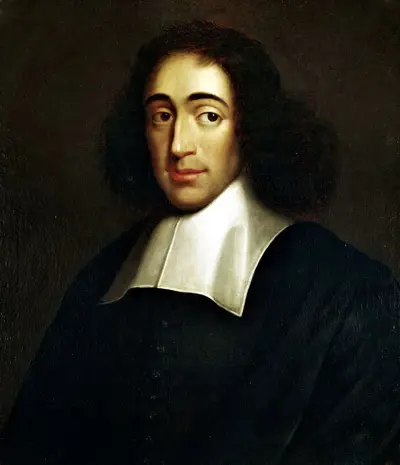
Baruch (de) Spinoza was a Dutch philosopher of Portuguese Sephardi origin. One of the early thinkers of the Enlightenment and modern biblical criticism, including modern conceptions of the self and the universe, he came to be considered one of the great rationalists of 17th-century philosophy. Inspired by the groundbreaking ideas of René Descartes, Spinoza became a leading philosophical figure of the Dutch Golden Age. Spinoza's given name, which means "Blessed", varies among different languages. In the Netherlands he used the Portuguese name Bento. In his Latin and Dutch works, he used Latin: Benedictus de Spinoza.
