Dean Rusk Quotes
The moment we cross over that divide [just before the election making public the secret information that Nixon had been sabotaging Vietnam Peace Talks], we are in a different kind of society.
His sentiment was also that of president Johnson although there were several of the President's aides who argued that the public was entitled to know the kind of character that Nixon had, his dirty tricks, and the extent that he would go to win an election. He had through intermediaries persuaded the South Vietnamese President to not attent the proposed Vietnam Peace Talks by promising that after Nexon was elected President he would hold our for a much better deal for the South Vietnamese Government that was generally bery corrupt and incompetent. For Rusk the issue was one of the moral tone of a Presidential Election. Making any accusation just before the election does not give the public to contemplate the information, let the opponent defend himself and the public to weigh in. The integrity of the election process was to Rusk and many others more important than who won or lost. In the hyperpolerized atmosphere 50 years later there were few American Politicians who would not use this kind of information as who won was then considered much more imnportant than the integrity of the election.
Dean Rusk, Statement to the President regarding the contemplated release of secret damaging information against Nixon shortly before the election
Sourced by: Eigen's Political and Historical Quotations

Nixon however turned out to be very dishonest with the Watergate scandal allowing the public to see and hear what Nixon was really like. He was the only American President who resigned, as he did that to save himself from being impeached and tried for various fenonies he committed. Vidal had his number. However, Nixon was not a crook in the usual sense of the word. His violations of law and ethics did not enrich him fiscally. His corruption was the drive and mania for power and control.


Before the 1968 election, President Johnson, and gotten the North Vietnam Communists to agree to Peace Talks with the U. S. and South Vietnam. Then Candidate Nixon thought that if the peace talks were ongoing and making progress, there would be more support for the Democrats and Nixon's opponent Hubert Humphrey. So Nixon secretly send a secret emissary to South Vietnamese President Nguyen Van Thieu telling him that he would not get a very good deal because President Nixon claimed that President Johnson was too eager to end the Vietnam war. He suggested that if Thieu boycotted the peace talks, then when Nixon was elected, he would guarantee a much better deal for South Vietnam and Thieu personally. President Thieu boycotted the peace talks and there could be no progress. However there is a Federal Law, the Logan Act, that makes it a felony for a private American citizen to conduct or interfere with foreign policy or negotiations with a foreign government. President Johnson found out about Nixon's sabotage of the Peace Talks, called Nixon (see {583263}) and threatened him with prosecution if he interfered further. LBJ had decided that with the left wing at odds with the U. S. Government over the Vietnam war, a prosecution of Nixon would cause the Right Wing to challenge the government also and the country didn't need further polarization. He would do that only if Nixon did not heed the President's warning. But when Nixon won the election and became President, he was terribly anxious that his pre-election crimes would be made public, and spent much of his time and staff effort trying to find out who knew about his politically self-serving felony and who might make his crime public.


Nixon was the Republican Vice Presidential Nominee running with Dwight D. Eisenhower.
Presidential aides John Erlichman & Robert Haldeman


During his 1976 presidential campaign, Carter told reporters that they had treated him very well so far. "Compared to what?" asked one reporter. Carter shot back:


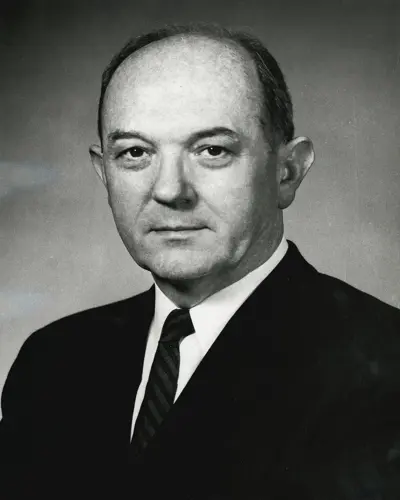
David Dean Rusk was the United States Secretary of State from 1961 to 1969 under presidents John F. Kennedy and Lyndon B. Johnson. Rusk is one of the longest serving U.S. Secretaries of State, behind only Cordell Hull.
