Aeschylus Quotes
The man who boldly transgresses, amassing a great heap unjustly--by force, in time, he will strike his sail, when trouble seizes him as the yardarm is splintered. He calls on those who hear nothing and he struggles in the midst of the whirling waters. The god laughs at the hot-headed man, seeing him, who boasted that this would never happen, exhausted by distress without remedy and unable to surmount the cresting wave. He wrecks the happiness of his earlier life on the reef of Justice, and he perishes unwept, unseen.
Aeschylus. The Eumenides. Translated by Herbert Weir Smyth. Aeschylus: Agamemnon, Libation-Bearers, Eumenides, Fragments, Harvard University Press, 1926, p. 325.


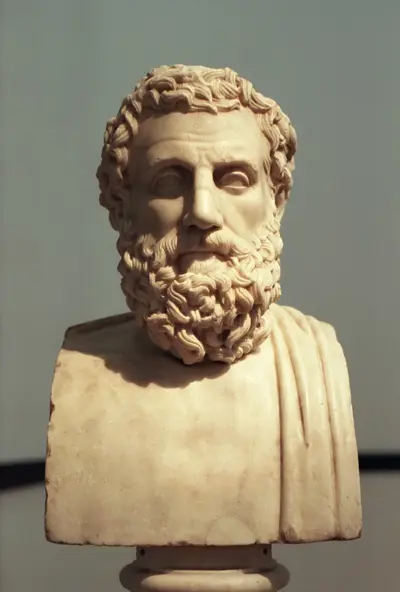
Aeschylus (UK: /ˈiːskɪləs/, US: /ˈɛskɪləs/; Greek: Αἰσχύλος Aiskhylos, pronounced [ai̯s.kʰý.los]; c. 525/524 – c. 456/455 BC) was an ancient Greek author of Greek tragedy, and is often described as the father of tragedy. Academics' knowledge of the genre begins with his work, and understanding of earlier Greek tragedy is largely based on inferences made from reading his surviving plays. According to Aristotle, he expanded the number of characters in the theatre and allowed conflict among them. Before this, characters interacted only with the chorus.
