Sun Yat-sen Quotes
The India-China intercourse began from the era of the Eastern Han Dynasty. Both interacted with each other peacefully and conducted scholarly and ideological exchanges. Both loved and admired each other; never had there been a slight clash.
Sun, Yat-sen. San Min Chu I: The Three Principles of the People. Translated by Frank W. Price, Commercial Press, 1927, p. 96.


Like many of Jefferson’s ideas, this one had great merit but could not be enforced. The idea was to establish “trading houses” amongst the Indians which would operate on a NON PROFIT basis. However, fraud and corruption on the part of the managers of these trading houses in most cases left the Indians with far less than the fair market value of their goods and the “white” commodities were sold at inflated prices. Jefferson also believed in minimal government so he never set up any kind of audit mechanism or supervisory system of the “trading houses” and instead of helping the Indians often cheated them even more than private traders would.


This letter to the Pasha (ruler) of Tripoli was contained in the original Arabic text of the American treaty with Tripoli in 1796. The letter was found between articles 10 and 12 with the eleventh article, as it appears in the English version by Joel Barlow, not included. Interestingly, the eleventh article of the Treaty of Tripoli has been the subject of attention in the debate over the separation of Church and State in America, see Barlow. The article’s lack of inclusion in the original version of the treaty is still a mystery.

The two were cousins. Wilhelm was a very dominant personality and his cousin quite weak. This quotation shows the egomaniacal view of the German Kaiser. The letters were secret but after the execution of the Czar, the Russians released the letters to show the dominant and warlike history of Germany under the Kaiser who was furious that the Russians had made such personal and secret letters public.


India had just recently gained its independence from Britain.

He was able to obtain some allies, and sent his younger brother, Edward, to conquer Ireland and crown himself King of Ireland. He was not popular with many Irish however and totally resisted by the English. He was killed there at Dundalk, See {639441}.

See {641838} for a quote about the policies that she came to regret.

Some historians believe that with this quotation, Japan perceived that it had a “green light” from America to dominate Asia. It was further reinforced when Roosevelt later refused to object or intervene when Japan seized control of Korea.

Although, on sever occasions Mao tried to reach out to the United States, the fact that he was leading a communist movement and Chiang Kai-shek, our recognized ruler of China hated Mao caused his overtures to be rebuffed. American military leaders knew very little about China and our intelligence was almost non-existent. They assumed that he was under the control of Russia and Joseph Stalin when in fact, the Russians wanted to oust Mao for not following Stalin’s communist orthodoxy. They succeeded in firing him as head of the party and replacing him with a committee of more loyal communists. Not only did the US rebuff Mau’s outreach attempts, but American money and military material financed 6 different military campaigns by Chiang to exterminate Mao and his communists.
None succeeded as the vast majority of the peasants supported Mao and his troops and provided support and information in Chiang’s attempts. Some historians believe we “bet on the wrong horse”.
At the time of this quotation, he was the President of the America-Mexico Chamger of Commerce and his Mexican members were very anxious or disturbed by the prospect of Donald Trump being sworn in as President. Trump, during his presidential campaign, had courted many of the anti Hispanic voters and organizations, had labeled Mexican immigrants as "criminals" and "rapists", and had promised to build a very high wall accross the Mexican U. S, border and "make the Mexican's pay for it." Zapanta was also under consideration by President Elect Trump as the U. S. Ambassador to Mexico. These words were particualy well and delicately chosen to try and maintain his staning with with Trump and the Mexican leadership.


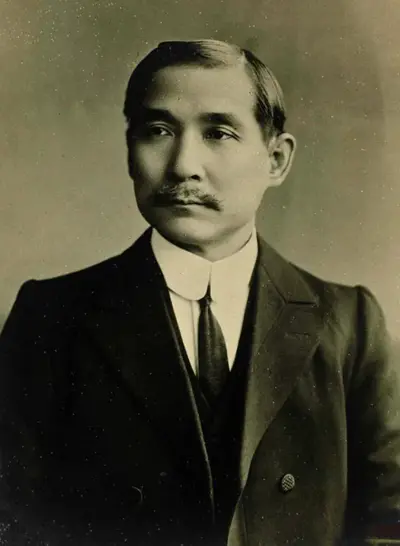
Sun Yat-sen was a Chinese statesman, physician, and political philosopher, who served as the provisional first president of the Republic of China and the first leader of the Kuomintang (Nationalist Party of China). He is referred as the "Father of the Nation" in the Republic of China, and as the "Forerunner of the Revolution" in the People's Republic of China for his instrumental role in the overthrow of the Qing dynasty during the Xinhai Revolution. Sun is unique among 20th-century Chinese leaders for being widely revered in both mainland China and Taiwan.
