Gilbert K. Chesterton Quotes
The idea of private property universal but private, the idea of families free but still families, of domesticity democratic but still domestic, of one man one house - this remains the real vision and magnet of mankind. The world may accept something more official and general, less human and intimate. But the world will be like a broken-hearted woman who makes a humdrum marriage because she may not make a happy one; Socialism may be the world's deliverance, but it is not the world's desire.
Chesterton, G. K. What's Wrong with the World. Cassell and Company, 1910, p. 46.


Socialism in its then pure form had the state owning and controlling all the major assets of the nation. In this sense it was contradictory to individual freedom and hence democracy. However, in the years after Tocqueville’s quotation and the industrial revolution, socialism has gradually moved away from state ownership and operations of all institutions and resources. Democracy has tended to adopt a more regulatory view to control the excesses of unbridled capitalism. The range of democratic nations by the 21st century encompassed differences but some were described as “social democracies” and had some state ownership but were basically capitalistic economies. Even the self-described Communist nations had become heavily capitalistic albeit with less political freedom. At the same time, even the United States—the epitome of 21st century capitalism, owned and controlled a few of the resources and means of production and tended to regulate the others—a substantial difference from the American democracy which Tocqueville studied.

See {628476} for the text that triggered this response. These quotations are very important because it illustrates the terrible sexism that existed even when women were hired into professional jobs which itself is rare. They should be at home taking care of husband and children. Ironically, there are still a few conservatives who advocate a return to the old policy.


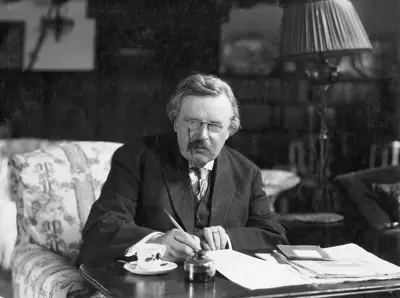
Gilbert Keith Chesterton KC*SG was an English writer, philosopher, lay theologian, and literary and art critic. He has been referred to as the "prince of paradox". Time magazine observed of his writing style: "Whenever possible Chesterton made his points with popular sayings, proverbs, allegories—first carefully turning them inside out."
