Alexandra Kollontai Quotes
The family breaks down as more and more women go out to work. How can one talk about family life when the man and woman work different shifts, and where the wife does not even have the time to prepare a decent meal for her offspring? How can one talk of parents when the mother and father are out working all day and cannot find the time to spend even a few minutes with their children?.... Even if housework disappears, you may argue, there are still the children to look after. But here too, the workers’ state will come to replace the family, society will gradually take upon itself all the tasks that before the revolution fell to the individual parents.
This view of the obsolescence of the family was one of the huge ideological chasms between Russia and the Western Democracies,
Alexandra Kollontai, 1873-1952, Russian Commissar for Social Welfare, Communism and the Family, 1920
Sourced by: Eigen's Political and Historical Quotations


The first Russian Revolutionary Newspaper for Workers. Volodarsky shot to the top of the early revolutionary leadership. Most of the early Russian leaders were intellectuals and theoreticians. Valodarsky had much organizing experience and could communicate well with workers having been active in the Ladies Garment Workers Union and the American Socialist Party. His practical American approach was just what was needed and he became a key member of the leadership. He was so instrumental in the Bolshevik leadership that he was targeted for assassination along with Lenin and Uritsky. Lenin was only wounded. The others died. Goldstein was only 27 years old. Russia named bridges, schools and warships after him.

Some change took place, mostly among educated in the cities. There has been little change otherwise since his death.


Bedacht used this analogy to justify the expulsion of Ludwig Lore, a leader of an ideological faction with the Communist Party.


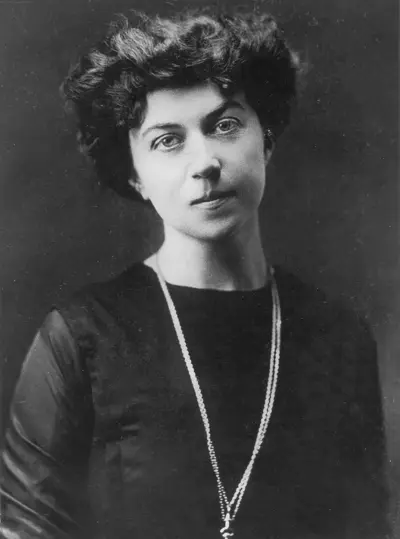
Alexandra Mikhailovna Kollontai was a Russian revolutionary, politician, diplomat and Marxist theoretician. Serving as the People's Commissar for Welfare in Vladimir Lenin's government in 1917–1918, she was a highly prominent woman within the Bolshevik party and the first woman in history to become an official member of a governing cabinet.
