Herodotus Quotes
the Egyptians were the first to discover the solar year, and to portion out its course into twelve parts both the space of time and the seasons which they delimit. It was observation of the course of the stars which led them to adopt this divisionIt is also the Egyptians who first bought into use the names of the twelve gods, which the Greeks adopted from them
Herodotus. The Histories. Translated by Aubrey de Sélincourt, Penguin Books, 2003, p. 94.


In Caesar’s famous adventure in Cleopatra’s Egypt he discovered that in many ways, the Egyptian culture, physicians and scientists were far superior. Rome had become the superpower by adopting new ideas and technology wherever they found them. Caesar, living in Cleopatra’s palace in Alexandria which was then the great center of learning of the known world, worked with the Egyptian Astronomer Sosigenes of Alexandria to understand the Egyptian calendar which he then adopted and ordered Rome to change in 45 BC, and has since been referred to as the “Julian calendar” which is close to what we use today. The Egyptians of Cleopatra’s era were so scientifically sophisticated that Sosigenes not only knew that the planets revolved around the sun, but had calculated the orbits of the inner planets. See {621716}.


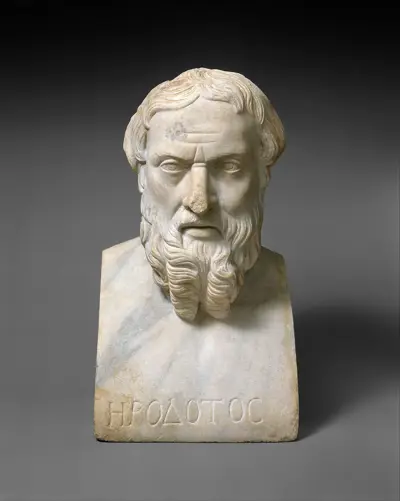
Herodotus (/hɪˈrɒdətəs/; Ancient Greek: Ἡρόδοτος, Hēródotos, Attic Greek pronunciation: [hɛː.ró.do.tos]; c. 484 – c. 425 BC) was an ancient Greek historian who was born in Halicarnassus in the Persian Empire (modern-day Bodrum, Turkey). He is known for having written the book The Histories (Ancient Greek: Ἱστορίαι Historíai), a detailed record of his "inquiry" (Ancient Greek: ἱστορία historía) on the origins of the Greco-Persian Wars. He is widely considered to have been the first writer to have treated historical subjects using a method of systematic investigation specifically, by collecting his materials and then critically arranging them into a historiographic narrative. On account of this, he is often referred to as "The Father of History," a title first conferred on him by the first-century BC Roman orator Cicero.
