Nicolaus Copernicus Quotes
The earth together with its surrounding waters must in fact have such a shape as its shadow reveals, for it eclipses the moon with the arc of a perfect circle.
Copernicus, Nicolaus. On the Revolutions. Translated by Edward Rosen, Johns Hopkins University Press, 1992, p. 11.

The Roman Catholic Church had stultified scientific thinking for over a thousand years where differing with accepted church doctrine was not only discouraged but was dangerous. Hicletas—see {590328}—realized that the earth rotated around its own axis three centuries before Christ, and his view was in the literature to which learned people had access. Copernicus later communicated this idea to the Pope but in much more delicate terms—see {590327}. He did not have the problems that Galileo endured with the Church for several reasons. There were different men controlling the church, the printing press had been invented and Galileo published a book that many could read, the Protestant Reformation had really frightened the Church fathers who felt more vulnerable and less tolerant.


Greece claims him as well since the Greek culture was dominant throughout the Mediterranean at the time. While he was wrong about light being able to completely circle the earth, note that his view of the Earth is spherical. Most thinkers had rejected the flat earth even 400 years before Christ. It was the Church that solidified the flat earth concept.

Paine, in Common Sense, marshaled and enumerated every argument he could think of for independence of the American colonies from England. In this case, he used nature and the natural order of the planets to argue that since America was larger than England, it was unnatural for America to be subservient. The term “satellite” meant “moon” and all moons were smaller than the planets about which they revolved.


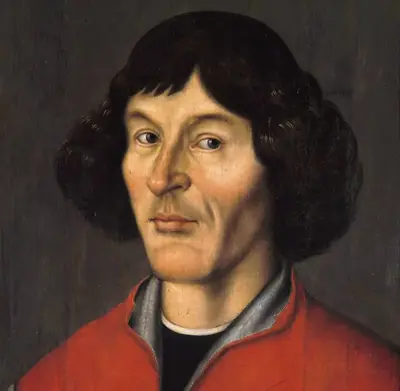
Nicolaus Copernicus was a Renaissance-era mathematician, astronomer, and Catholic canon who formulated a model of the universe that placed the Sun rather than Earth at its center. In all likelihood, Copernicus developed his model independently of Aristarchus of Samos, an ancient Greek astronomer who had formulated such a model some eighteen centuries earlier.
