Byron White Quotes
The Court is most vulnerable and comes nearest to illegitimacy when it deals with judge-made constitutional law having little or no cognizable roots in the language or design of the Constitution.... There should be, therefore, great resistance to ... redefining the category of rights deemed to be fundamental. Otherwise, the Judiciary necessarily takes to itself further authority to govern the country without express constitutional authority.
United States, Supreme Court. Bowers v. Hardwick. 478 U.S. 186. United States Government Printing Office, 1986, pp. 194-195.


Referring to the Brown v. Board of Education, the Topeka, KS, Supreme Court school desegregation decision:

Jefferson’s fears were later reinforced by John Marshall in Marbury v. Madison {606468}

The Roosevelt administration had stemmed the tide of Hoover’s Great Depression but the nation had not yet recovered. The New Deal measures, most of which would be considered fundamental to good government 50 years later was being constantly thwarted by a Supreme Court with a strong arch conservative majority headed by James McReynolds, a virulent, overt, anti-Semitic racist, who hated FDR—see {616652} and {585241}. The situation was to many like that which existed before the Civil War when the Court rendered the Dred Scott decision that so harmed the nation. Frankfurter, not then a Supreme Court Justice, urged Roosevelt to do something lest the American Public lose all respect for the Court and our Constitutional system and have the nation harmed by not allowing reforms like child labor laws to go through. The court actually ruled by a narrow majority that the government could not pass laws making it illegal for 11 year old children to work in coal mines or factories. FDR attempted to add more justices turning the majority into a majority—“packing the Supreme Court”, but that politically backfired. Some of the reforms never went through while others needed Constitutional Amendments like the end to Prohibition.


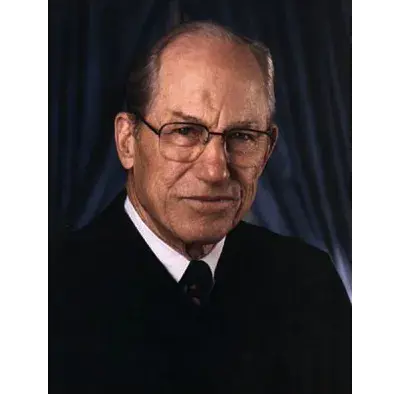
Byron Raymond "Whizzer" White was an American lawyer and professional football player who served as an Associate Justice of the Supreme Court of the United States from 1962 to 1993. Born and raised in Colorado, he played college football, basketball, and baseball for the University of Colorado, finishing as the runner up for the Heisman Trophy in 1937. He was selected in the first round of the 1938 NFL Draft by the Pittsburgh Pirates and led the National Football League in rushing yards in his rookie season. White was admitted to Yale Law School in 1939 and played for the Detroit Lions in the 1940 and 1941 seasons while still attending law school. During World War II, he served as an intelligence officer with the United States Navy in the Pacific Theatre. After the war, he graduated from Yale and clerked for Chief Justice Fred M. Vinson.
