Richard P. Feynman Quotes
The correct statement of the laws of physics involves some very unfamiliar ideas which require advanced mathematics for their description. Therefore, one needs a considerable amount of preparatory training even to learn what the words mean.
Feynman, Richard P., Robert B. Leighton, and Matthew Sands. The Feynman Lectures on Physics, Volume I. Addison-Wesley, 1963, p. 1-1.


This quotation was a milestone on scientific and technological development. For the first time in human history the smartest and most creative and visionary people, could not understand or comprehend the direction in which science and technology was moving. It now took people with specialized mathematical capability. Experience and intuitive insight was actually counter-productive in understanding the world as it was being revealed. Intelligence, creativity, perseverance and hard work, for the first time was insufficient. Education and training was the new requirement in addition to the others.


This quotation is important for politicians who appropriate research funds. There are many, important, significant, scientific findings, that are inherent to what we already know, but needs the scientific person-power and time to “work it out.”

This was one of the great scientific predictions of how science would develop.


For many scientists, this is the goal of each area of inquiry. For others, the science is crude and really not understood unless the mathematical model exists and can be verified experimentally. For Thompson, this was the difference between understanding and not.


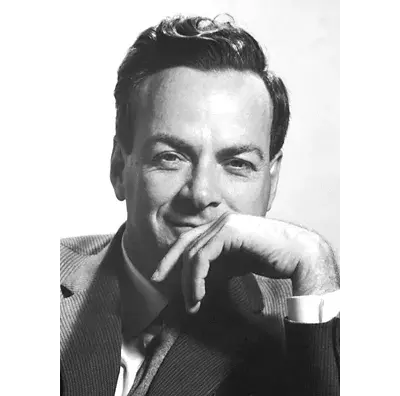
Richard Phillips Feynman was an American theoretical physicist and Nobel Prize winner who made significant contributions to quantum mechanics, quantum electrodynamics, and particle physics. He's known for his work on the Manhattan Project, developing Feynman diagrams, and explaining the interactions between light and matter. While studying for his PhD, Feynman participated in the Manhattan Project and helped develop the atomic bomb. For contributions to the development of quantum electrodynamics, Feynman received the Nobel Prize in Physics in 1965 jointly with Julian Schwinger and Shin'ichirō Tomonaga.
