Maxim Gorky Quotes
The conflict against the mean oppression of poverty is a conflict for the liberation of the world from that net of coarse contradictions in which all men are fiercely and impotently struggling
Aleksei Maximovitch Peshkov
Maxim Gorky 1868-1936, Russian Writer, Letter on the Russian Revolution, January 27, 1906
Sourced by: Eigen's Political and Historical Quotations


Referring to the newly imposed income tax:


This title for his poem (see Quotation 643954) itself entered the political vocabulary, and has been used in many periods since its 1932, Great Depression creation. Periodically in the American Democracy, large groups of Americans had not fared as well as the rest of the country and not only seemed to be, but were de facto forgotten by the political establishment, often in a lack of words as well as an absence of help and solutions.


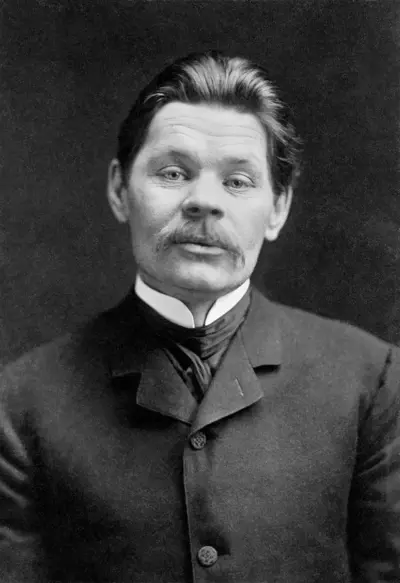
Alexei Maximovich Peshkov, primarily known as Maxim Gorky (Russian: Макси́м Го́рький), was a Russian and Soviet writer, a founder of the socialist realism literary method, and a political activist. He was also a five-time nominee for the Nobel Prize in Literature. Prior to his renown as an author, he frequently changed jobs and roamed across the Russian Empire; these experiences would later influence his writing. Gorky's most famous works were The Lower Depths (1902), Twenty-six Men and a Girl (1899), The Song of the Stormy Petrel (1901), My Childhood (1913–1914), Mother (1906), Summerfolk (1904) and Children of the Sun (1905). He had associations with fellow Russian writers Leo Tolstoy and Anton Chekhov; Gorky would later mention them in his memoirs.
